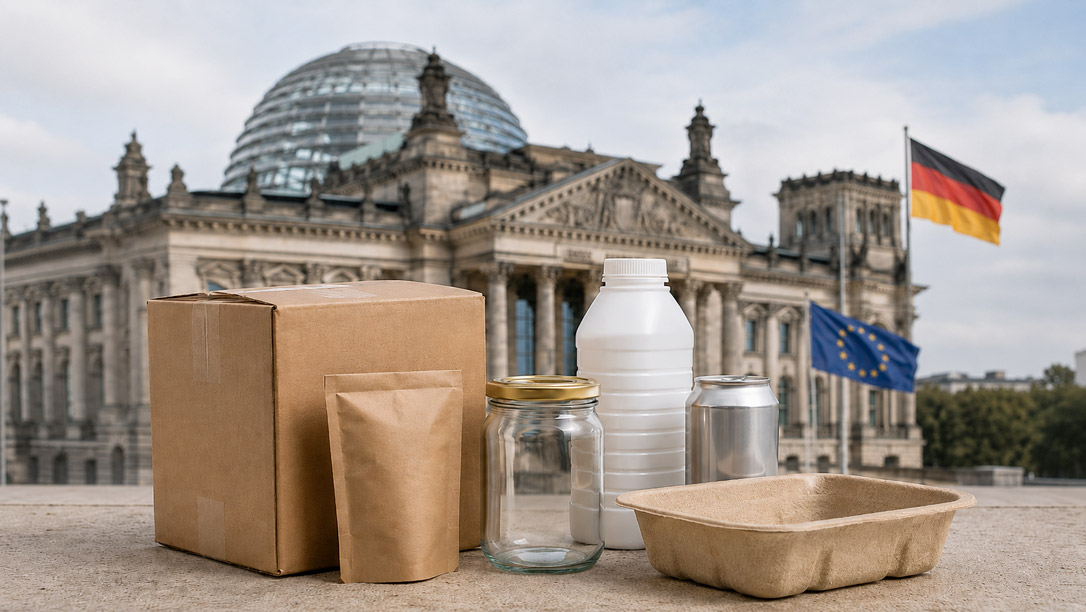
As Germany moves forward with its national packaging law, the case highlights one of the key challenges of PPWR implementation: turning EU-wide packaging rules into practical, workable systems for companies, regulators and national markets.
The European Commission’s decision to withdraw its detailed opinion on Germany’s draft packaging law may look, at first glance, like a procedural update. For the packaging industry, however, it marks a significant step in PPWR implementation: the moment when EU packaging rules begin to meet the complexity of national systems.
After years of debate around the Packaging and Packaging Waste Regulation, the focus is shifting from Brussels to the market. The question is no longer only what the PPWR requires, but how those requirements will be applied in Member States with existing packaging compliance systems, established EPR schemes, national registers and deposit-return infrastructure.
Germany is one of the most important countries in which to observe this transition. Its packaging regulation system is mature, highly structured and deeply embedded in business practice. For companies placing packaged goods on the German market, obligations around registration, reporting, producer responsibility and recovery are already part of daily operations.
This makes the German case more than a domestic legal development. It is an early test of what happens when the PPWR’s promise of EU harmonisation meets national reality.
What happened to Germany’s draft packaging law
Germany notified its draft law for implementing the PPWR through the EU’s TRIS procedure, the mechanism used to assess whether national technical regulations are compatible with EU law. The draft aims to adapt the German legal framework to Regulation (EU) 2025/40, the Packaging and Packaging Waste Regulation.
In practical terms, the new German Packaging Law Implementing Act is designed to replace the existing Packaging Act and align national rules with the PPWR. It addresses key areas such as extended producer responsibility, producer registration, recycling requirements, reporting obligations, deposit systems, beverage packaging and the role of the Central Agency Packaging Register.
The European Commission initially raised concerns through a detailed opinion. These concerns focused on possible inconsistencies between the German draft and the directly applicable provisions of the PPWR. In particular, the Commission examined definitions and obligations relating to material recycling, distributors, plastic packaging, producer registration, EPR and reporting.
Following Germany’s response and clarifications, the Commission withdrew its detailed opinion. This removes a significant procedural obstacle and reduces the risk of a gap between the PPWR’s application date and the national measures needed to make the German system operational.
This does not mean every issue is closed. But it does show that the PPWR is entering a new phase. It is no longer simply a regulatory text. It is becoming an implementation challenge.
Why Germany matters for PPWR implementation
Germany already has one of Europe’s most developed packaging compliance systems, with established structures for extended producer responsibility, packaging registration, data reporting and deposit-return schemes. These systems are familiar to producers, retailers, importers and packaging suppliers operating in the German market.
That is exactly why the German case is so relevant. The PPWR is designed to create a more harmonised framework across the EU, reducing regulatory fragmentation and setting common requirements for packaging sustainability, recyclability, recycled content, reuse, waste prevention and market access.
But harmonisation does not happen in a vacuum. It must be implemented in countries where legislation, administrative structures and market practices already exist.
Germany’s draft packaging law appears to follow a pragmatic direction: preserving and adapting existing structures where possible, while aligning them with the PPWR. This approach could help avoid unnecessary disruption for companies and regulators. At the same time, it highlights the delicate balance that Member States will need to manage.
Too much national divergence would weaken the PPWR’s objective of creating a more consistent European packaging market. Too little attention to existing systems, however, could create legal uncertainty, administrative complexity and avoidable costs.
For the packaging industry, this balance is not a technical detail. It will determine how companies experience the PPWR in practice.
From EU packaging regulation to national implementation
The PPWR will generally apply from 12 August 2026. For the packaging value chain, that date is becoming increasingly important because it marks the transition from preparation to operational compliance.
The German draft law reflects the scale of this shift. It deals with extended producer responsibility, take-back, collection and recovery of packaging, beverage packaging, deposit systems, recycled content for single-use beverage packaging, the central packaging register and the obligation to offer reusable alternatives in certain food and beverage consumption contexts.
These are not abstract regulatory categories. They affect how packaging is designed, registered, placed on the market, collected, reported and financed.
For brand owners, PPWR implementation means that packaging compliance will need to be integrated earlier into portfolio management, packaging development and market strategy. For packaging manufacturers and converters, technical specifications will increasingly need to be assessed not only in terms of performance and sustainability, but also in terms of regulatory acceptance. For importers, distributors and retailers, the key questions will concern responsibility, documentation, registration and data flows.
This is one of the most important messages emerging from the German case: PPWR readiness is not only a legal department issue. It is a business issue involving regulatory teams, procurement, packaging development, sustainability, supply chain, sales and market access.
What German PPWR implementation means for packaging companies
The first impact for companies will be organisational. Businesses selling packaged products in Germany will need to monitor how the German packaging law is finalised and how responsibilities are allocated under the new framework.
Extended producer responsibility will remain central. So will producer registration, reporting obligations and the interaction between national systems and EU-level requirements. The Commission’s initial concerns show how sensitive this area is: the PPWR is directly applicable, but national systems still need to function in a practical and legally consistent way.
A second major issue is data. As EU packaging rules become more detailed, companies will need reliable information on materials, packaging formats, recyclability, recycled content, packaging categories, sales channels and countries of market placement.
In many organisations, this data is still fragmented. Some information sits with suppliers, some with packaging developers, some with procurement, some with compliance teams and some with external EPR service providers. Under the PPWR, this fragmentation will become harder to manage.
The German case therefore sends a clear signal: companies should not wait for every national detail to be finalised before preparing. They should start mapping their packaging portfolios, identifying the markets they serve, checking existing EPR and registration obligations, and assessing whether their internal data systems are ready for the PPWR era.
This is particularly important for international companies, including those exporting to Germany. A company may be compliant in one EU market and still face additional operational requirements in another, especially during the transition period in which national systems are being adapted to the new European regulation.
In this context, packaging compliance becomes more than a regulatory obligation. It becomes a condition for market access.
A test case for EU packaging regulation
The withdrawal of the Commission’s detailed opinion should not be read simply as a green light for Germany. It should be read as an early sign of the complexity that lies ahead across the EU.
The PPWR is intended to reduce fragmentation and create clearer, more consistent rules for packaging across the internal market. But the implementation phase will inevitably reveal points of friction: definitions, national registers, reporting obligations, deposit systems, reusable packaging requirements, EPR responsibilities and enforcement mechanisms.
Germany is one of the first major examples of this process becoming visible. Other Member States will face similar questions as they adapt their own legal frameworks. Some will need to integrate advanced national systems with the PPWR. Others will need to build new administrative capacity almost from scratch.
In both cases, companies will need clarity, consistency and enough time to adapt.
For the packaging industry, the issue is not whether the PPWR will reshape the European market. It already is. The more important question is how smoothly that transformation can be managed, and whether national implementation will support or complicate the regulation’s objective of harmonisation.
What packaging companies should watch next
The next step is the finalisation of Germany’s national packaging law and the practical guidance that will follow from competent authorities and registration bodies. Companies should pay close attention to how Germany defines operational responsibilities, how existing structures are maintained, and how national requirements interact with directly applicable PPWR provisions.
They should also watch whether Germany becomes a reference point for other Member States. If its approach proves workable, it may influence how other national systems are adapted. If implementation challenges emerge, they may offer an early warning for the wider European packaging market.
What is already clear is that packaging compliance is becoming increasingly strategic. It is no longer only about meeting isolated legal obligations. It is about protecting market access, reducing regulatory risk, managing packaging data, supporting sustainability claims and aligning business decisions with the future shape of the EU market.
Germany’s case shows that the PPWR is entering its most important phase: the point at which regulation meets reality. For the packaging sector, that is where the real work begins.