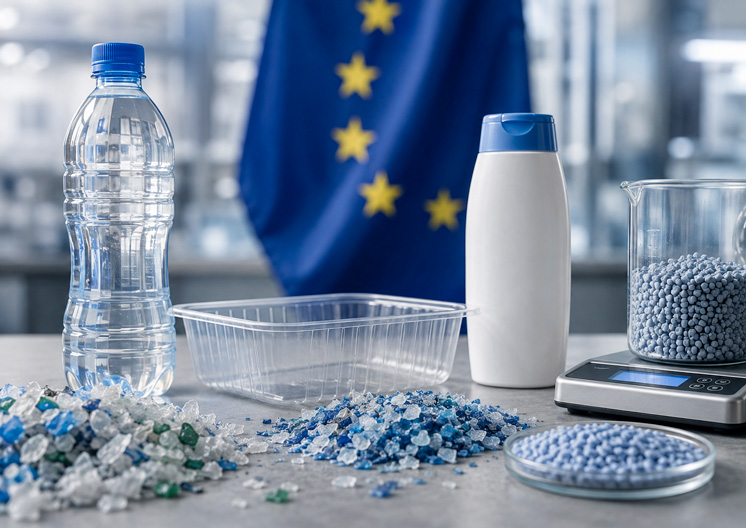
Just days after the Packaging and Packaging Waste Regulation (PPWR) became generally applicable across the European Union, the European Commission has opened a new call for evidence on one of the regulation’s most consequential areas for the plastics packaging value chain: how mandatory recycled content requirements will work in practice.
The consultation, launched on 14 August 2026 and open until 16 September 2026, concerns three pieces of secondary legislation linked to Article 7 of Regulation (EU) 2025/40. Together, they are expected to define the methodology for calculating and verifying recycled content, establish sustainability criteria for plastic recycling technologies and determine how recycled material originating outside the EU can be assessed against equivalent requirements.
For packaging manufacturers, converters, recyclers, brand owners and importers, these are not minor technical details. Article 7 already establishes minimum levels of post-consumer recycled plastic that certain packaging will have to contain, but the secondary legislation now under development will determine what can count towards those targets, how compliance can be demonstrated and under which conditions imported recyclate can be used.
The targets are set, but the calculation rules still need to be defined
Under the PPWR, plastic packaging will be required to incorporate minimum percentages of recycled content recovered from post-consumer plastic waste. For the first phase, Article 7 sets different levels depending on the type of packaging: 30% for contact-sensitive packaging with PET as the major component, 10% for contact-sensitive packaging made from plastics other than PET, 30% for single-use plastic beverage bottles and 35% for other plastic packaging, subject to the exemptions provided by the Regulation.
Those percentages, however, do not tell companies everything they need to know to demonstrate compliance.
Article 7(8) requires the Commission to establish a harmonised methodology for calculating and verifying the percentage of recycled content recovered from post-consumer plastic waste. The methodology is also important because the PPWR calculates recycled content as an average per manufacturing plant and year, rather than necessarily requiring every individual packaging unit to contain exactly the stated percentage. The Commission has previously confirmed this plant-and-year approach in its PPWR implementation material.
The implementing act is due by 31 December 2026. This deadline is particularly relevant because the application of the recycled-content targets is linked to it: the requirements apply from 1 January 2030 or three years after the entry into force of the Article 7(8) implementing act, whichever is later. Consequently, the timing of the secondary legislation is itself something packaging companies should continue to monitor rather than treating January 2030 as an entirely standalone compliance date.
Which recycling technologies will qualify?
A second part of the Commission’s work concerns sustainability criteria for plastic recycling technologies, as required by Article 7(9).
This could become particularly significant as the industry increases its reliance on different recycling routes to produce sufficient volumes and qualities of recycled polymers. The PPWR does not simply aim to increase the quantity of recycled material entering packaging; the Commission is also required to consider the environmental performance of the technologies used to produce that material.
The resulting criteria could therefore influence which recycling processes and material streams are able to contribute effectively to Article 7 compliance. The debate is likely to be especially relevant to the relationship between mechanical and chemical recycling technologies, where questions around environmental performance, traceability, allocation methods and the calculation of recycled content have already become important industry issues. The European chemical industry, for example, has argued that the criteria should remain technology-neutral and assess recycling routes on their actual performance.
For converters and packaging buyers, the practical implication is clear: specifying a percentage of “recycled plastic” may increasingly be insufficient on its own. The origin of the material, the recycling process behind it and the evidence supporting the recycled-content claim could all become part of the compliance chain.
Imported recycled plastic is another key issue
The third area addressed by the Commission concerns recycled plastic coming from outside the EU.
Article 7(10) requires a methodology for assessing, verifying and certifying whether rules applied when post-consumer plastic waste is collected or recycled in a third country are equivalent to the relevant EU requirements. The Regulation explicitly envisages verification and certification mechanisms, including third-party audits.
This provision has significant commercial implications. European packaging producers increasingly operate through international raw-material markets, while recycled polymers and packaged products themselves can enter the Union from global supply chains. If European recyclers are required to comply with specific collection, processing and environmental standards, imported recycled material will need a credible mechanism to demonstrate equivalent conditions if it is to compete on the same regulatory basis.
The final methodology may therefore affect not only compliance departments but also procurement strategies, supplier qualification and the economics of recycled polymer sourcing. Documentation provided by non-EU recyclers could become an increasingly important part of the information requested by European converters and brand owners before material is approved for PPWR-compliant packaging.
From recycled-content claims to auditable evidence
The call for evidence highlights a broader change introduced by the PPWR. Recycled content is moving from being primarily a sustainability attribute or voluntary packaging claim to becoming, for many plastic packaging formats, a measurable regulatory requirement supported by harmonised documentation and verification rules.
For companies in the packaging value chain, the immediate task is therefore not simply to secure enough PCR material ahead of the future targets. It is also worth examining whether existing data systems can identify the source of recycled material, distinguish post-consumer recyclate from other recycled feedstocks, connect material information to individual manufacturing sites and preserve the documentation needed to support future conformity assessments.
Supplier agreements may also need to become more precise. A converter buying recycled resin will increasingly depend on information generated further upstream, while a brand owner will in turn depend on its packaging suppliers to provide reliable evidence supporting the recycled-content figures used in technical documentation.
That makes traceability and chain-of-custody information almost as important as the percentage printed on a specification sheet.
The Commission’s current consultation gives recyclers, packaging manufacturers, material suppliers and other stakeholders an opportunity to provide evidence before these methodologies are finalised. With feedback open until 16 September 2026 and the three Article 7 measures scheduled for adoption by the end of the year, the next few months will be important in determining how one of the PPWR’s headline circularity requirements translates from legislation into day-to-day packaging compliance.