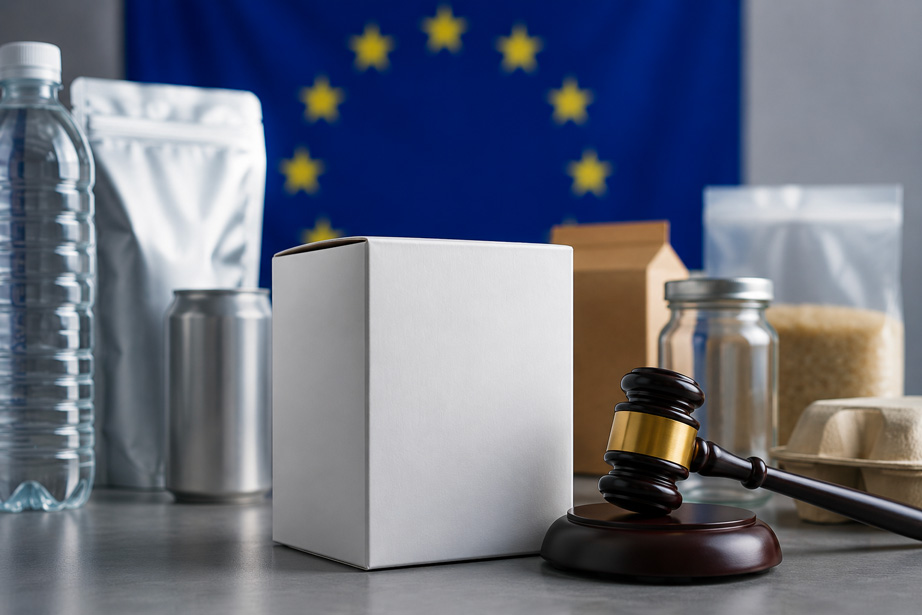
As the Packaging and Packaging Waste Regulation moves towards its general application on 12 August 2026, companies across the packaging value chain are facing a deceptively simple question: who is the manufacturer?
The answer is not always the company that physically produces the packaging. New FAQs published by the European Commission in August 2026 clarify how the role should be identified, particularly for branded products and transport packaging.
The distinction matters because the manufacturer is the economic operator responsible for ensuring that the packaging placed on the EU market complies with the PPWR, including the relevant conformity assessment, technical documentation and EU Declaration of Conformity.
A brand owner can be the manufacturer
Under the PPWR, when packaging or a packaged product is designed or manufactured under a company’s own name or trademark, that company will generally be considered the manufacturer. This remains the case even where another operator physically manufactures, fills or packs the product.
The Commission also clarifies that selecting a standard packaging solution does not automatically remove this responsibility. A company may still be the manufacturer even if it does not request changes to the design or production process.
This makes the definition particularly relevant for private-label products, contract manufacturing and co-packing arrangements. Responsibility cannot be identified solely by looking at who operates the packaging line: the name or trademark under which the packaging is placed on the market must also be considered.
A specific exception applies to micro-enterprises. Where the company under whose name or trademark the packaging is marketed is a micro-enterprise and the supplier is established in the same Member State, the supplier of the packaging or packaged product becomes the manufacturer.
The situation becomes more complex when the packaging displays the name of one company and the trademark of another. In these cases, the decisive factor is which operator determines the packaging design and specifications. A licensor that only allows its trademark to appear on the packaging, without controlling its characteristics, should not automatically be treated as the manufacturer. The contractual relationship must therefore be assessed case by case.
Transport packaging must be assessed in its final form
The new FAQs provide particularly detailed guidance on transport packaging.
Its manufacturer must be identified when the empty packaging has reached its final form — meaning that it can perform its packaging function without additional components or ancillary elements being added.
A flat cardboard box, for example, is already considered to be in its final form even if it still needs to be folded. If the box carries a company name or trademark, that company is the manufacturer. For a generic, unbranded box, the manufacturer will normally be the company that physically produces it. A shipping sticker added later does not count as branding and does not transfer the manufacturer role to the company using the box.
The same principle applies to stretch wrap. Film sold on a roll is already considered packaging, even though it will later be cut and wrapped around a pallet. Where it is unbranded, the manufacturer is the company that produces the film and places it on the market as packaging, not the business that subsequently uses it to stabilise a load.
Crucially, the Commission confirms that a single shipment may contain packaging from several different manufacturers. Boxes, pallets, tape and wrapping materials can each already constitute packaging in their final form, with each manufacturer responsible for providing the information and documentation required to demonstrate conformity.
Responsibility cannot simply be transferred by contract
Once identified, the manufacturer remains legally responsible for the compliance of the packaging it places on the market.
Some activities can be carried out by third parties. A laboratory or certification scheme may perform the conformity assessment, while an authorised representative may help prepare or retain certain documents. However, the technical documentation must be compiled under the manufacturer’s responsibility, and the ultimate legal liability for compliance cannot be transferred through contractual arrangements.
Suppliers must provide the information needed to demonstrate conformity, but the manufacturer remains the operator legally responsible for placing compliant packaging on the market.
For brand owners, converters, fillers, retailers and logistics operators, the practical message is clear: PPWR roles should be assessed for each packaging item and each commercial arrangement.
Identifying the manufacturer is no longer simply a question of asking who made the packaging. It requires companies to examine branding, specifications, contractual control and the point at which each packaging item reaches its final form.