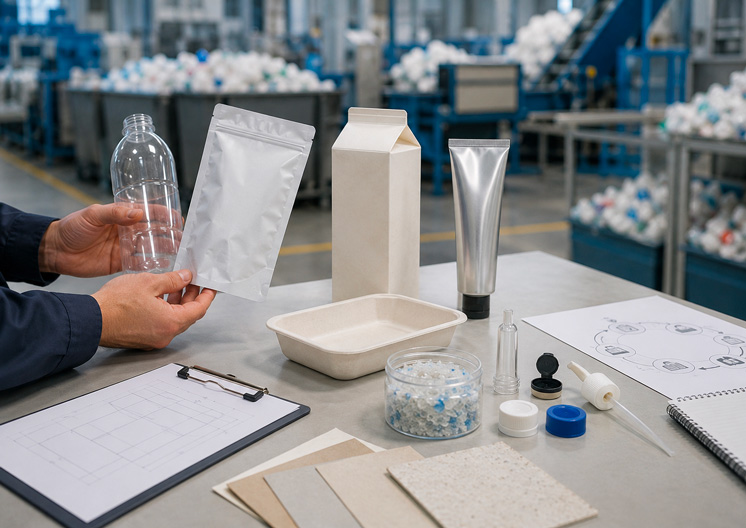
The Packaging and Packaging Waste Regulation, better known as PPWR, is one of the most ambitious regulatory shifts ever introduced for the European packaging industry.
Its direction is clear: less unnecessary packaging, more recyclable materials, higher recycled content, stronger responsibility across the value chain and a decisive move away from linear packaging models. In principle, few would argue against its goals. A packaging system that generates less waste, uses fewer virgin resources and supports a functioning circular economy is not only desirable, but increasingly necessary.
Yet as the regulation moves from legal text to practical application, the conversation is changing. The question is no longer whether packaging circularity is a good idea, the real question is whether the packaging system, as it exists today, is ready to make it work.
The PPWR in brief: what is really changing?
The PPWR replaces the previous Packaging and Packaging Waste Directive with a regulation that applies directly across the European Union. This is already a major change in itself, because it aims to create a more harmonised framework for packaging requirements across Member States.
At its core, the PPWR introduces requirements that affect the entire packaging life cycle: design, material composition, recyclability, reuse, waste prevention, labelling, extended producer responsibility and the use of recycled content. It covers all packaging placed on the EU market, regardless of material, sector or origin.
The direction is not only environmental. It is also industrial and economic. The PPWR is designed to make packaging circularity measurable, enforceable and comparable across markets. It wants to move the industry away from fragmented sustainability claims and towards common rules, common definitions and common obligations.
This is why the PPWR is not simply another compliance update. It is a structural change in the way packaging is designed, specified, sourced, documented and evaluated.
But structural change is never only a matter of regulation, it is also a matter of feasibility.
From regulatory ambition to operational reality
For years, packaging sustainability has often been discussed through broad principles: reduce, reuse, recycle, design for circularity, eliminate unnecessary materials. The PPWR translates many of these principles into obligations.
This is where things become more complex.
A company can redesign a pack to make it lighter, but that does not automatically make it circular. It can switch to a mono-material structure, but that does not guarantee that local sorting and recycling systems can process it effectively. It can commit to recycled content, but that content must be available, technically suitable, safe for the intended application and economically viable.
The PPWR therefore exposes a crucial gap between “design intent” and “system performance”.Packaging circularity does not happen inside a single company: it depends on converters, brand owners, retailers, waste operators, recyclers, regulators, municipalities and consumers. It also depends on data flows, collection infrastructure, sorting technology, recycling capacity and end markets for secondary raw materials.
In other words, the PPWR asks companies to comply, but the success of compliance depends on an ecosystem that is not equally mature everywhere.
The recycled content challenge
One of the most sensitive areas is recycled content, particularly in plastic packaging. The idea is straightforward: if packaging uses more recycled material, demand for secondary raw materials increases and the economics of recycling improve.
In reality, the picture is more complicated. High-quality recycled material is not always available in the volumes required. Food-contact applications, cosmetics, pharmaceuticals and other sensitive sectors face additional technical, safety and regulatory constraints. Flexible packaging and multilayer structures remain particularly challenging because they are often difficult to collect, sort and recycle at scale.
This creates a potential mismatch between regulatory demand and market supply.
If many companies need certified, high-quality recycled content at the same time, competition for suitable material may increase. Prices may rise. Smaller players may struggle to secure reliable supply. Some applications may require technical compromises, while others may need more time for innovation, testing and validation.
This does not mean recycled content targets are wrong. On the contrary, they may be essential to creating stable demand. But they require a functioning market behind them. Without enough capacity, quality and traceability, recycled content risks becoming one of the most difficult areas of PPWR implementation.
Recyclable in theory does not always mean recycled in practice
Another key point is recyclability. The PPWR pushes the industry towards packaging that is recyclable in an economically viable way. This is a necessary step, because too many packs have historically been described as recyclable based on theoretical material properties rather than real end-of-life outcomes.
But recyclability is not a single yes-or-no attribute: a packaging format may be technically recyclable, but if it is not collected in a given country, if sorting facilities cannot identify it, if contamination is too high, if the recycling output has no stable buyer, or if the economics do not work, the circular loop remains incomplete.
This is especially relevant in a European market where waste management systems are still highly uneven. Some countries have advanced collection and sorting infrastructure; others are still developing the capacity needed to process more complex material streams. Even within the same country, regional differences can be significant.
This is where the PPWR forces the industry to confront an uncomfortable truth: packaging design alone cannot solve circularity.
Design for recycling is essential, but it is only the first step. A circular packaging system also needs infrastructure, consumer participation, operational funding, reliable sorting, recycling capacity and demand for recycled materials.
Without these elements, recyclable packaging can still become waste.
Are packaging companies ready for PPWR?
The answer may vary according to different factors, that may also result in inequality of market opportunities.
Large multinational groups often have sustainability departments, regulatory teams, supplier management systems and the resources to run packaging audits across hundreds or thousands of SKUs. They can invest in testing, redesign, certification, data management and long-term procurement strategies.
For small and medium-sized businesses, the transition may be much harder. Many SMEs do not have internal regulatory experts. They may rely heavily on suppliers for packaging specifications. They may not have full visibility over material composition, recyclability performance, recycled content verification or country-specific obligations. For them, PPWR compliance is not only a packaging challenge, but also an organisational one.
The regulation will require companies to know more about their packaging than ever before. Not only what it looks like and how much it costs, but what it is made of, where the material comes from, how it performs, how it can be collected, whether it can be recycled at scale, and how its claims can be documented.
This represents a major shift from packaging as a purchasing item to packaging as a regulated data asset.
In this sense, the companies best positioned for the PPWR will not necessarily be those with the most sustainable-looking packaging today. They will be those with the strongest control over data, suppliers, documentation and material strategy.
When responsibility becomes part of the challenge
There is another layer of complexity that the PPWR is already bringing to the surface: responsibility.
In theory, regulatory responsibility should be clear. In practice, packaging supply chains are often built around multiple actors: material suppliers, converters, fillers, brand owners, retailers, importers and distributors. The question of who is responsible for compliance, documentation, extended producer responsibility and system participation can quickly become more complex than the packaging itself.
Germany is already offering an early example of this operational reality. Recent discussions around own-brand and private-label packaging show that PPWR implementation is not only about designing packaging that meets new sustainability requirements. It is also about defining who must bear responsibility for it.
For private labels, the issue is particularly sensitive. A product may be manufactured by one company, filled by another and sold under the name of a retailer. Under the PPWR, this raises practical questions with direct financial and legal consequences: who is considered responsible for the packaging placed on the market? Who must provide the data? Who must participate in EPR systems? Who pays for system participation? And how should these obligations be reflected in contracts between retailers and suppliers?
This is where the PPWR becomes more than an environmental regulation. It becomes a matter of governance.
The responsibility question also highlights a broader issue: circularity requires traceability. Companies will need reliable information on packaging materials, weights, formats, suppliers, markets and end-of-life pathways. Without this data, even basic compliance tasks can become difficult. For private-label products and imported goods, the challenge may be even greater, because information has to move across commercial relationships that were not always designed for regulatory transparency.
This does not undermine the logic of the PPWR. On the contrary, it shows why the regulation is so disruptive. It is not only asking companies to change packaging materials or formats. It is asking them to redefine accountability across the value chain.
For retailers, brand owners and suppliers, this means that PPWR readiness cannot be limited to packaging design. It must also include legal interpretation, supplier engagement, data collection, contract review and internal ownership of compliance processes.
In this sense, the regulation is forcing the packaging industry to answer a question that has often remained in the background: who really owns packaging responsibility?
The answer will matter, because circularity cannot work if responsibility is fragmented, unclear or transferred informally from one actor to another. A circular packaging system needs not only recyclable materials and recycling infrastructure, but also clear accountability.
PPWR and the cost of transition
Another aspect to consider is the costs of this transition.
Circular packaging is often discussed as a long-term efficiency opportunity, but the short-term transition can be expensive. Redesigning packaging portfolios, changing materials, testing alternatives, adapting production lines, validating recycled content, updating labels, collecting data and managing compliance across markets all require investment.
In some cases, more sustainable options may also be more expensive, at least initially. Recycled materials can cost more than virgin materials. Reusable systems may require reverse logistics, washing infrastructure and new operational models. Paper-based alternatives may need barrier coatings that affect recyclability. Lightweight flexible packs may have a lower carbon footprint in transport, but a more difficult end-of-life profile.
This is why the PPWR cannot be reduced to a simple hierarchy where one material is always better than another.
The real challenge is not choosing the most sustainable-looking option, but identifying the solution that performs best across the full life cycle, complies with the regulation, protects the product, works for consumers and can be managed at scale.
For packaging teams, this means trade-offs will become more visible. Sustainability, compliance, cost, performance, safety and consumer experience will need to be evaluated together.
PPWR and the risk of “checklist compliance”
One of the biggest risks is that the PPWR becomes a checklist exercise.
Companies may focus on meeting individual requirements without questioning the broader packaging system they are part of. They may chase compliant claims, update documentation and change materials only where necessary, without using the regulation as an opportunity to rethink packaging strategy.
This would be a missed opportunity. The PPWR should not be seen only as a legal obligation, but be treated as a strategic trigger. It forces companies to ask difficult but useful questions: Is this packaging necessary? Can it be simplified? Can materials be reduced? Is the design compatible with real recycling streams? Are sustainability claims supported by evidence? Are suppliers ready? Is data reliable? Is the packaging portfolio future-proof?
The companies that approach the PPWR only as compliance may avoid immediate risk. But the companies that approach it as transformation may gain a stronger competitive position.
Because in the coming years, packaging will not only be judged by how it looks, how it protects or how much it costs. It will increasingly be judged by whether it can prove its place in a circular economy.
Can packaging circularity work in the real world?
The honest answer is: yes, it could, but not automatically. The PPWR gives the packaging industry a direction, but regulation alone cannot build a circular system. Targets can create pressure. Deadlines can accelerate action. Harmonised rules can reduce fragmentation. But the real work happens in implementation.
Circularity will depend on whether recycled material markets can scale. It will depend on whether infrastructure can keep up with regulatory ambition. It will depend on whether companies can redesign packaging without compromising safety, performance or accessibility. It will depend on whether consumers receive clear information and whether waste systems can process what the market places on shelves.
Most importantly, it will depend on collaboration: no brand owner can make packaging circular alone. No converter can solve recyclability without downstream systems, no recycler can create value without stable demand, no regulation can succeed if the operational conditions are missing.
This is the real PPWR reality check. The regulation is ambitious, and ambition is needed. But its success will not be measured only by the number of companies that update their packaging files or adjust their labels. It will be measured by whether packaging actually moves through the economy differently: with less waste, better material recovery, stronger data, more responsible design and a more resilient circular infrastructure.
The PPWR is not the finish line for packaging circularity. It is the beginning of a much harder phase: turning circularity from a promise into a working industrial model.
And that is where the real test begins.