After the European Union adopted its BPA ban for food contact materials in December 2024, with the regulation entering into force in January 2025, the coatings industry is facing a new phase of reformulation, testing and certification. The transition away from Bisphenol A is no longer only a matter of long-term innovation or regulatory anticipation. It is becoming a practical industrial challenge for companies that rely on high-performance coatings in applications where food, beverages or drinking water may come into direct or indirect contact with treated surfaces.
For many sectors, the question is no longer whether safer alternatives will be needed, but how quickly they can be developed, validated and brought closer to market. Coatings must continue to provide durability, chemical resistance and technical performance, while also meeting increasingly strict safety expectations around migration and exposure to endocrine disruptors. In this context, BPA-free alternatives are moving from regulatory expectation to concrete industrial requirement.
AIMPLAS, the Plastics Technology Centre, and FAKOLITH are working on this transition through the SAFE-ED Coatings project, an initiative focused on the development of new coating systems capable of reducing or eliminating the migration of endocrine disruptors. The project, coordinated by FAKOLITH with the participation of AIMPLAS, aims to develop up to four innovative coating systems suitable for direct and indirect contact with food, beverages, drinking water and other industrial or construction-related applications.
The objective is ambitious: to reduce the migration of endocrine disruptors to undetectable levels, below 1 ppb, or to eliminate it entirely, while maintaining the technical performance required for demanding applications. This balance between safety, compliance and functionality is becoming increasingly important as existing solutions based on bisphenol-derived resins and additives face replacement, reformulation or stricter validation requirements.
After the BPA Ban, Coatings Face a Reformulation Challenge
Bisphenol A and other endocrine disruptors have been under growing scientific and regulatory attention due to their potential effects on hormonal and reproductive systems. In Europe, this concern has already translated into a major regulatory shift, with the adoption of new rules restricting BPA and other hazardous bisphenols in certain food contact materials and articles.
For the coatings sector, this creates a complex challenge. Many existing high-performance systems, including certain epoxy coatings, have historically relied on bisphenol-based chemistry because of its durability, resistance and functional properties. However, once a material is affected by stricter food contact rules, technical performance alone is no longer enough. Coatings must also demonstrate that they are safe, compliant and suitable for the contact conditions in which they are used.
This is where projects such as SAFE-ED Coatings become strategically relevant. They do not simply respond to a future regulatory possibility, but to a changed compliance landscape in which many traditional solutions need to be reassessed. Coatings are increasingly expected to deliver not only mechanical and chemical performance, but also demonstrable compliance with stricter migration requirements and long-term toxicological expectations.
Marta García, R&D&I Director at FAKOLITH, highlighted this point in the project announcement, noting that the speed of legislative change is making many existing solutions obsolete. Her statement reflects a broader concern for the industry: after the BPA ban, companies need viable technologies that allow them to maintain operational continuity while adapting to new safety and certification requirements.
SAFE-ED Coatings Targets Undetectable Migration Levels
The SAFE-ED Coatings project is designed to provide a technical, health and regulatory response to this changing scenario. Its work focuses on the development of coating systems that can be used in environments where safety requirements are particularly strict, including direct food and beverage contact, direct contact with drinking water, food industry installations involving indirect contact, and construction or civil engineering surfaces.
FAKOLITH is leading the development and formulation of the new coating systems, working according to three main principles: elimination, reduction and encapsulation of endocrine disruptors. This means that the project is not only looking at replacing problematic substances, but also at controlling their possible migration and ensuring that the resulting systems remain functional for real industrial use.
The research began with a pool of at least 80 raw materials, of which around 60 are expected to meet the requirements for direct food contact while also being suitable for the new coating formulations. This selection phase is particularly significant because the replacement of bisphenol-based components cannot be treated as a simple one-to-one substitution. Alternative materials must be safe, regulatory compliant and technically compatible with the performance demands of the final application.
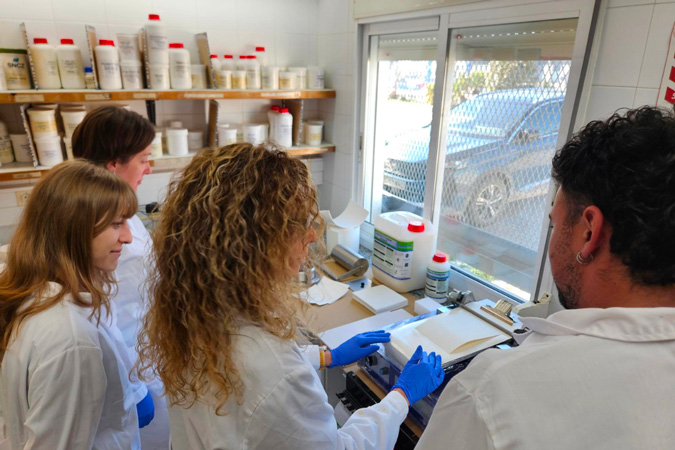
AIMPLAS is contributing its expertise in legislation, testing and risk assessment. The technology centre has evaluated the regulatory documentation of the raw materials, defined the necessary tests according to current and upcoming requirements, and is adapting methodologies to reach increasingly strict limits for coatings. According to Mª Carmen Moreno, researcher at the Food Contact and Packaging Laboratory at AIMPLAS, the centre is expanding its testing methodologies for coatings in order to meet the new regulatory limits.
This analytical and regulatory dimension is essential. In food contact applications, innovation is not only measured by the development of new materials, but also by the ability to prove that they comply with current and future requirements. As migration thresholds become more demanding, testing methods and risk assessment protocols become part of the innovation process itself.
From Food Packaging to Drinking Water and Industrial Surfaces
Although the project is highly relevant for food contact materials, its scope extends beyond packaging alone. SAFE-ED Coatings is expected to have an impact on sectors such as the food industry, construction, civil engineering, healthcare and drinking water facilities. This wider application field reflects the fact that coatings are often used in complex environments where direct and indirect contact risks must be carefully managed.
In food production and processing environments, for example, coatings may be applied to surfaces that do not form part of the packaging itself but still play a role in overall food safety. The same applies to drinking water infrastructure, where material safety and migration control are fundamental requirements. As regulatory expectations become more demanding, the distinction between packaging materials, contact surfaces and industrial coatings becomes increasingly relevant for companies managing compliance across their operations.
The project also aims to support the use of more sustainable alternatives, including bio-based materials, while ensuring operational continuity for applications affected by restrictions on bisphenols. This point is important because the move away from BPA and related substances cannot create a performance gap for industries that depend on durable and resistant coatings. Safer alternatives must be able to function in real environments, not only in laboratory conditions.
For manufacturers, applicators and the wider coatings value chain, the transition towards BPA-free and endocrine disruptor-free systems will require technical knowledge, certification pathways and regulatory clarity. SAFE-ED Coatings is therefore positioned not only as a research project, but also as a knowledge transfer initiative designed to help industry adapt to a new compliance landscape.
The project is expected to conclude at the end of 2026 and is funded by the European Union’s NextGenerationEU programme through the Recovery, Transformation and Resilience Plan, with the support of the State Research Agency of the Spanish Ministry of Science, Innovation and Universities.
The EU ban on BPA in food contact materials has made the search for safer coating systems more urgent and more concrete. For companies working with food contact materials, drinking water systems and sensitive industrial surfaces, the ability to develop certified and industrially viable alternatives is becoming a competitive factor. BPA-free coatings are therefore moving from regulatory discussion to practical implementation, and projects such as SAFE-ED Coatings show how the industry is preparing for this new phase.
Image Credits: AIMPLAS