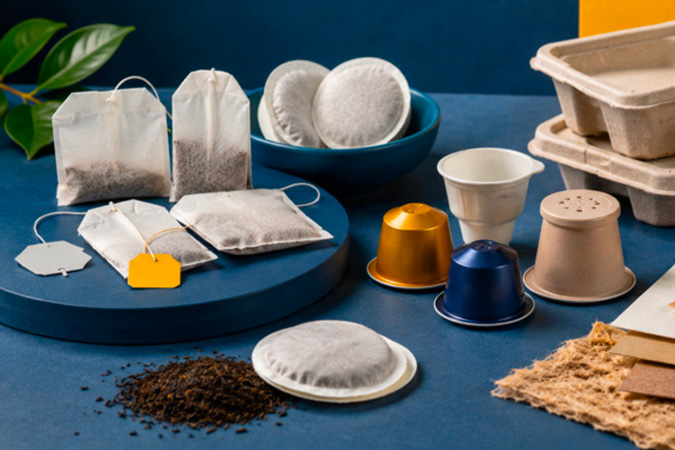
A tea bag may appear to be part of the product rather than its packaging. It contains the tea leaves, enters the water with them and is eventually discarded with the remaining contents. The same applies to many coffee pods and other single-serve beverage units.
Under the Packaging and Packaging Waste Regulation, however, this close relationship with the product no longer places these formats outside the packaging framework. From 12 August 2026, tea and coffee bags that are not left empty after use will formally be classified as packaging.
The change reflects the function these items perform. The PPWR defines packaging as an item used for the containment, protection, handling, delivery or presentation of products. Tea bags and coffee pods contain a pre-portioned product, protect it until use and enable it to be prepared in a specific format. The fact that they are used and discarded together with their contents does not remove that packaging function.
This is more than a change in terminology. Once these formats enter the PPWR framework, brands and manufacturers will need to treat them as regulated packaging and assess their design, composition and conformity accordingly.
Not all tea bags and coffee pods will follow the same rules
The PPWR distinguishes between different single-serve beverage systems according to their permeability, their condition after use and whether they are intended for use in a machine.
Permeable bags containing tea, coffee or another beverage fall within one category, together with single-serve units that become soft after use and are discarded with the product. These formats will be subject to mandatory compostability requirements.
Non-permeable units designed for use in a machine, including many rigid coffee capsules, are also considered packaging but are not automatically covered by the same EU-wide compostability obligation. Member States may require some non-metallic formats to be compostable where suitable bio-waste collection and treatment infrastructure exists. They cannot, however, impose compostability on metal capsules under this provision.
The result is a regulatory framework in which tea bags, soft coffee pods and rigid capsules may all qualify as packaging, while following different design and end-of-life pathways.
From classification in 2026 to material redesign in 2028
The two key dates should not be confused. Tea and coffee bags enter the packaging framework when the PPWR becomes generally applicable on 12 August 2026. The mandatory compostability requirement for the formats covered by Article 9 will apply from 12 February 2028. Until then, Member States are encouraged, but not required, to accept these packaging items in the bio-waste stream.
The PPWR does not prescribe one specific material from which future tea bags or soft coffee pods must be made. It establishes a performance requirement: the relevant packaging must be compostable.
For manufacturers, this means that compliance will not necessarily be achieved simply by replacing a plastic mesh with paper or switching to a bio-based material. The complete format will have to perform correctly in the intended composting process. Filter materials, barrier layers, sealing systems, adhesives, labels and other components may therefore need to be reviewed where they prevent the packaging from meeting the applicable requirements.
The Commission’s FAQs refer to the existing EN 13432:2000 standard in the context of industrial compostability and confirm that updated standards are being developed with the involvement of the industrial composting sector.
For tea and coffee brands, the regulatory shift therefore creates two stages of adaptation. The first is administrative and legal: recognising these units as packaging from August 2026. The second is technical: ensuring that the formats subject to Article 9 are designed for compostability by February 2028.
Some of the smallest items in the beverage aisle are about to become a much bigger packaging design challenge.