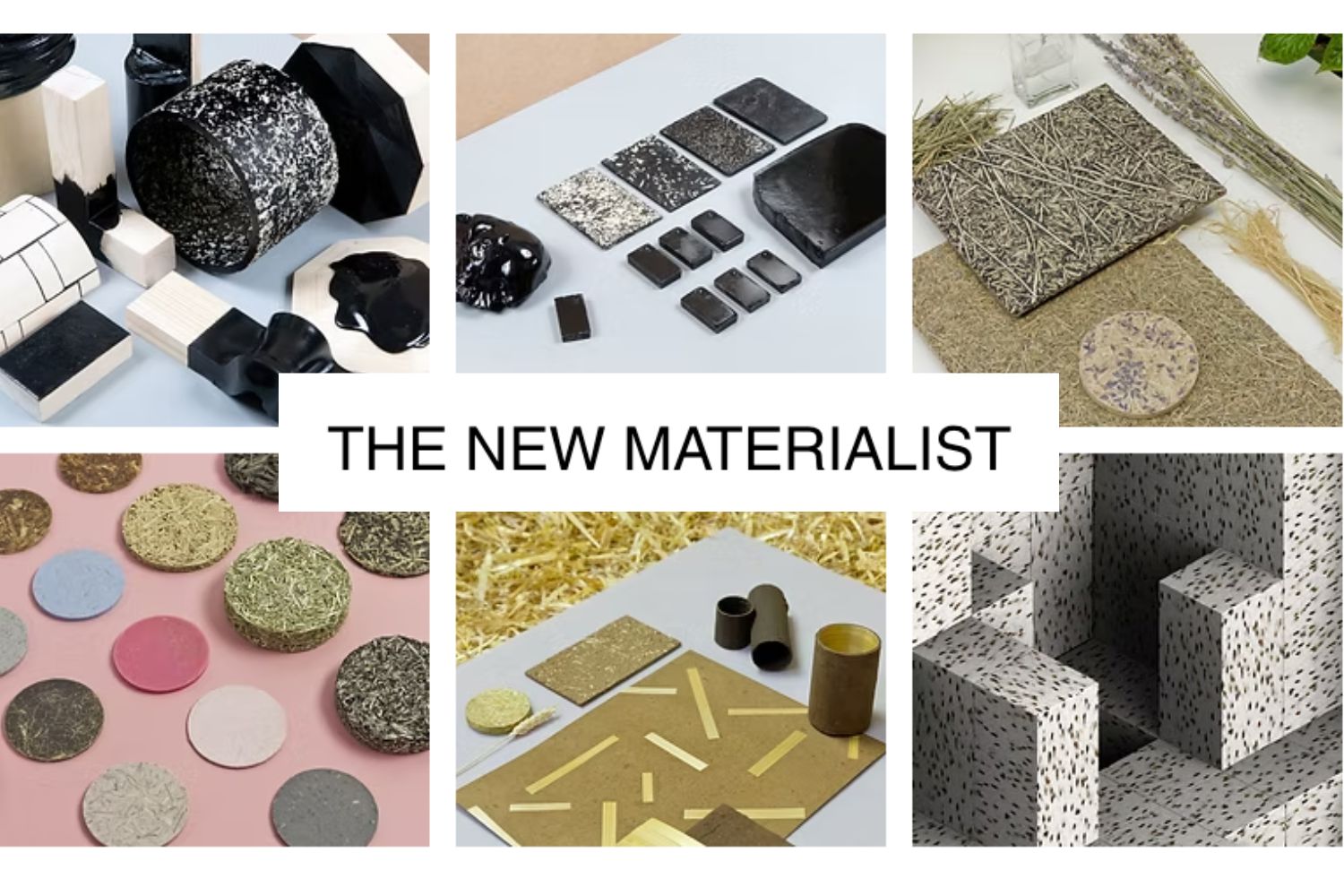
In Packaging, materials are not simply a technical choice. They are one of the most direct ways to change the physical reality of products, supply chains and, ultimately, consumer culture.
This is also the thinking behind the name of The New Materialist, a studio that works at the intersection of design, science, ecology and industrial development.
“We wanted a name that expressed a very clear idea: materials are the way we change the world at its core,” explains Baptiste Arribe, its co-founder, who also uses the meaningful expression “bio-natural innovation lab.”
In practical terms, The new Materialist helps brands introduce, develop and industrialize biomaterials for their products and, increasingly, for their packaging. Its work starts with bio-resources, prototypes and material research, but it does not end there. The ambition is to transform linear supply chains into more circular ecosystems and to make new materials usable at industrial level. “Our role is to help companies introduce and scale new materials – says Arribe – but in a broader sense, our mission is also providing solutions to challenges such as global warming.”
Material is “impactful” but Design is “king”
One of the most interesting aspects of The New Materialist’s approach is that it does not treat sustainability as a purely technical matter. For Arribe, the first point of contact between a material and the market is visual, sensory and emotional. In other words: design. Everything starts with design for us,” he says. “All the materials we design have to be aesthetic, because that is what the consumer sees first. Design is key.”
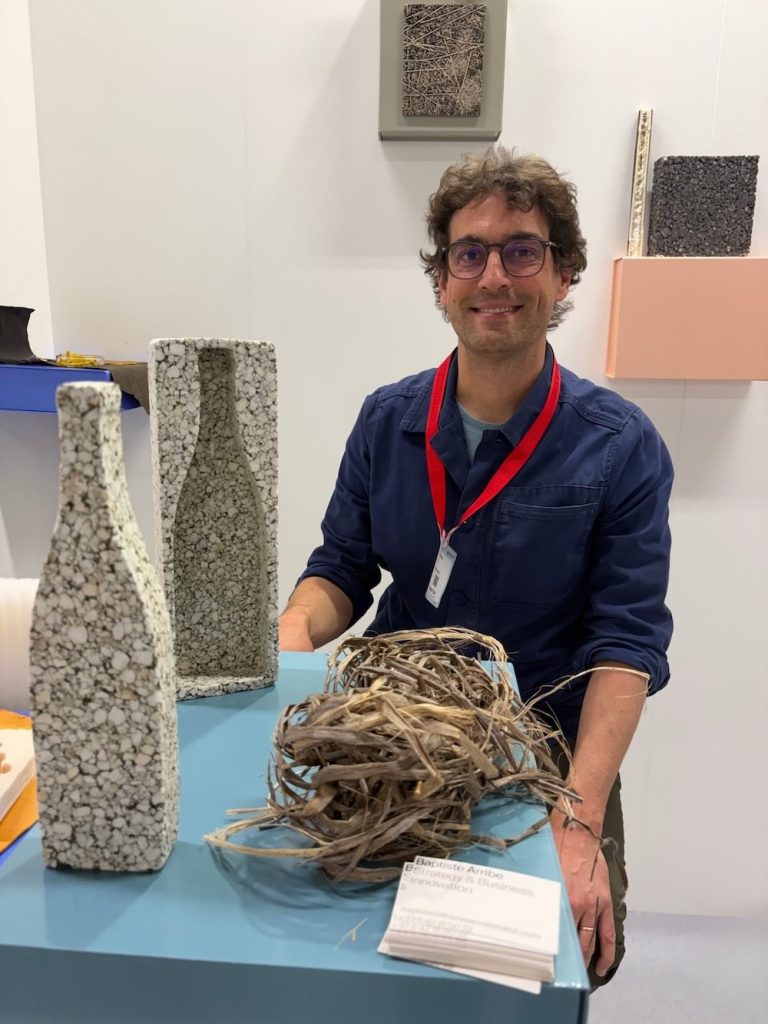
The New Materialist works on what Arribe calls systemic design: understanding not only the material itself, but also the context in which it will be produced, used, perceived and eventually recovered or transformed, considering its impact, performance and scalability. “We design impactful materials, but design is king,” he adds. “A material can be sustainable, but it also has to make sense for the product, for the brand and for the people who will interact with it.” This point is especially relevant for packaging. Too often, packaging innovation is discussed in terms of compliance, recyclability or carbon footprint alone. These are essential factors, but they do not fully explain whether a new solution will be accepted by brands, converters, retailers and consumers. For The New Materialist, the challenge is to connect environmental intent with desirability, feasibility and industrial logic.
From problem to material solution
Arribe’s background helps explain this dual approach. He is a mechanical engineer with a master’s degree in business. His partner, Thomas Vailly, is a designer of emerging materials. Together, they combine engineering, material exploration, design thinking and business understanding.
This combination allows the studio to work with companies that already know they need to change, but do not always know how.
“We usually work with quality managers and product managers,” Arribe explains. “They know the problems. They are aware that they need a change. Sometimes they have already tried something and it did not work. They brief us, and we find a solution.”
In other words, The New Materialist does not position itself as a research lab detached from market realities. Its goal is not to create experimental materials for their own sake, but to help brands move towards viable alternatives.
“We are solution makers,” says Arribe. “We look for real solutions to real problems.”
Around two thirds of the company’s missions are focused on the product itself, while packaging represents another important and growing area. This is not surprising. Packaging is often the first visible expression of a brand’s material choices, and it is increasingly under pressure from regulation, sustainability targets and consumer expectations.
A territory-based packaging project
One example Arribe mentions is a project for a French luxury brand that wanted to move towards packaging rooted in its own territory.
The request was not simply to replace one material with another. The goal was to create a packaging direction that could reflect the brand’s local identity, while also opening the door to more sustainable material options.
“We worked from their reality and expanded its nuances,” Arribe says. “We looked at their territory, their design language and their constraints, and we came back with around 20 possible alternatives.”
From those options, the brand selected two routes: one short-term solution and one longer-term development path.
This kind of work illustrates a broader shift in the way material innovation is entering luxury and premium markets. Brands are no longer looking only for a greener substitute that can be dropped into existing systems. Increasingly, they are looking for materials that can tell a story, express a place, carry meaning and still be scalable.
For luxury packaging in particular, this raises a complex question: can a new material deliver lower impact without sacrificing aesthetics, perceived value and brand distinctiveness?
The New Materialist’s answer is that it has to. Otherwise, the solution will not travel from concept to market.
Regulation will accelerate the search for alternatives
The packaging sector is also entering a new regulatory phase in Europe. The Packaging and Packaging Waste Regulation is pushing companies to rethink packaging design, recyclability, reuse, waste reduction and material choices.
For innovators such as The New Materialist, this could create new opportunities, but also new complexity.
“We expect a lot of calls because of the PPWR,” says Arribe. “It is not an easy rule for companies to comply with.”
The point is not only that companies will need to adapt. It is that many of them will need help translating regulatory pressure into concrete product and packaging decisions. What material should they choose? What can be industrialized? What makes sense for the brand? What will work in the market? What is genuinely more sustainable, rather than simply different?
Arribe believes the challenge is to create space for innovation while making it compatible with industrial and market constraints.
“We need to find a way to accept innovation and make it more sustainable for the market,” he says.
That sentence captures one of the central tensions in sustainable packaging today. The industry does not lack ideas. It often lacks the conditions that allow those ideas to scale.
Luxury, fashion, automotive and interiors: where change is coming first
Although packaging is a significant part of the conversation, The New Materialist works across several sectors. According to Arribe, the industries most affected by material change include automotive, luxury, construction, interior design and fashion.
Fashion and luxury, in particular, were among the first sectors to contact the company.
This makes sense. These industries face growing pressure to reduce impact, but they also rely heavily on materiality, perception and sensory value. A textile, a surface, a box, a case or an interior finish cannot be evaluated only by its technical specification. It also has to feel right.
“We have been surprised by how many industries are willing to change,” Arribe says. “There is much more openness than we expected.”
That openness does not mean the transition is simple. New materials have to pass through complex decision-making processes: quality requirements, sourcing, cost, manufacturing, compliance, performance, brand identity and consumer acceptance. But the fact that companies are willing to start the conversation is already meaningful.
For packaging, this could be especially important. As brands look beyond incremental improvements, material innovation may become a stronger lever for differentiation, not just for compliance.
A young company looking ahead
The New Materialist is still young. “We are a three-year-old company, and this is a year of change for startups,” he says. “We want to leave an impact and grow in a sustainable way.”
That final expression — grow in a sustainable way — applies both to The New Materialist and to the industries it serves. The future of biomaterials will not depend only on invention. It will depend on the ability to connect research, design, industrialization, regulation and market demand.
In packaging, this perspective is becoming increasingly relevant. The next generation of sustainable solutions will not be defined only by what they replace, but by what they make possible: new supply chains, new aesthetics, new relationships with local resources and new ways of designing impact into the product from the beginning.
The future of packaging may not begin with a finished pack. It may begin much earlier — with the material itself.
This is a change that requires determination and must necessarily involve the entire supply chain. The challenge is not an easy one, but organisations such as The New Materialist can act as a dynamic catalyst for change.