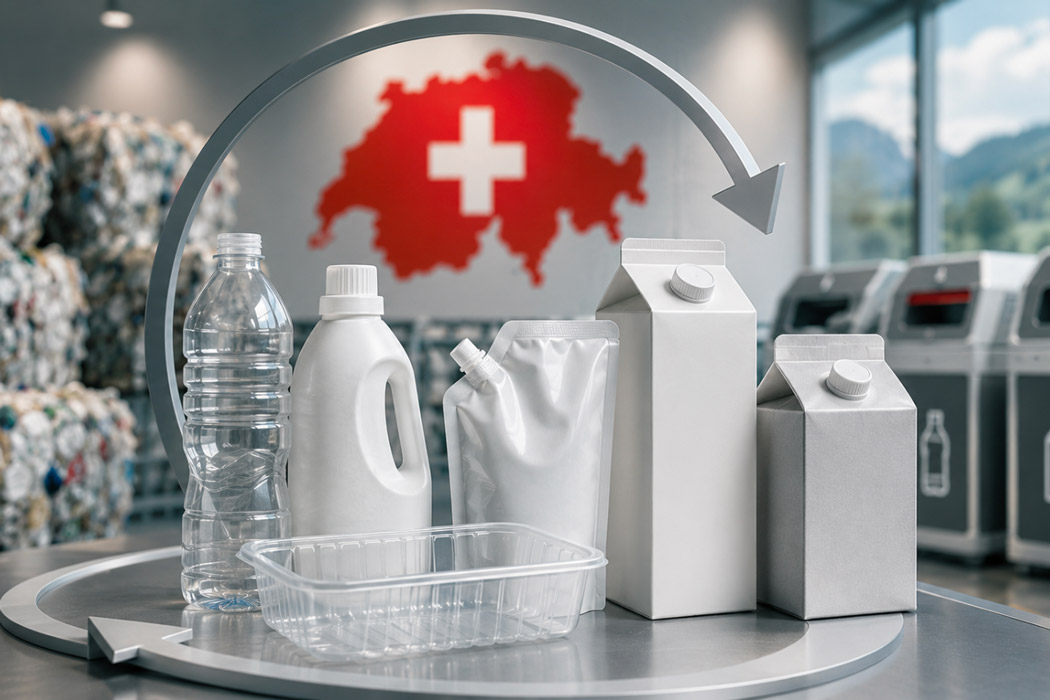
Packaging regulation is often shaped by the largest markets, but it is not defined by them alone. Smaller countries can also influence the direction of travel, especially when they introduce clear, measurable rules. Switzerland is now moving in this direction with a new packaging ordinance that sets minimum recycling rates for plastic packaging and beverage cartons.
Approved by the Swiss Federal Council on 24 June 2026, the new framework replaces the country’s 2000 Ordinance on Beverage Containers with a broader Packaging Ordinance. Its objective is to reduce the environmental impact of packaging by making it more recyclable, encouraging the use of recycled materials, avoiding unnecessary packaging and limiting substances of very high concern.
For the packaging industry, the move is significant not only because of the targets themselves, but because it shows how Switzerland is building its own circular packaging model outside the European Union. While the country is not governed by the EU Packaging and Packaging Waste Regulation, the direction of travel is clearly comparable: packaging is becoming more regulated, more measurable and more closely linked to end-of-life performance.
A new framework beyond beverage packaging
Until now, Swiss packaging regulation has been strongly associated with beverage containers. The new ordinance marks a shift towards a broader packaging policy, extending the regulatory focus to packaging design, material recovery, collection systems and transparency across the value chain.
The ordinance applies to packaging more generally and covers requirements for placing packaging on the market, take-back duties, disposal and the financing of glass packaging disposal. This broader scope is important because it moves the discussion beyond isolated waste streams and towards a more systemic approach to packaging circularity.
According to the new rules, manufacturers and retailers placing filled packaging on the Swiss market must ensure, where technically possible and economically viable, that packaging volume and mass are limited to what is necessary for product safety and hygiene. Packaging must also be suitable for collection, treatment and recycling, contain the highest possible share of recycled material and avoid substances of very high concern.
This makes the Swiss approach particularly relevant for packaging producers, brand owners, retailers and importers. The ordinance does not simply address what happens after packaging becomes waste. It also points upstream, towards design choices, material selection and the way packaging is placed on the market.
Minimum recycling rates for plastics and beverage cartons
One of the most important changes is the introduction of minimum material recycling rates for specific packaging streams.
The new ordinance sets a minimum recycling rate of 55% for take-back single-use plastic packaging and 70% for beverage cartons. If these targets are not achieved, the Federal Department of the Environment, Transport, Energy and Communications may introduce further measures, including mandatory take-back at companies’ own expense or a minimum deposit system for certain packaging.
These targets will become a key benchmark for the Swiss packaging market. They create a clearer performance expectation for plastic packaging and beverage cartons, two categories that are often central to discussions on collection efficiency, recyclability, consumer participation and the economic viability of material recovery.
The timing is also important. The ordinance is set to enter into force on 1 January 2027, but several provisions will follow a phased timeline: general packaging requirements will apply from 2030, the take-back duty for beverage cartons and single-use plastic packaging from 2031, and the article on insufficient recycling rates from 2032.
For companies, this phased approach creates a transition window. But it should not be read as a reason to wait. Packaging portfolios, supplier specifications and recovery partnerships usually require time to adapt, especially when compliance depends not only on the pack itself, but also on the performance of collection and recycling systems.
Take-back duties and the role of industry organizations
The ordinance also introduces a model based on take-back responsibility. Manufacturers and retailers placing beverage cartons and single-use plastic packaging on the Swiss market must ensure proper disposal either through membership of, or financial contributions to, an industry organization. If they do not, they must take back such packaging separately at the point of handover or nearby.
This structure is important because it combines regulatory obligations with space for sector-led systems. In practice, companies may rely on collective industry organizations, but they remain linked to the performance and credibility of the system. The ordinance also requires those involved in take-back to ensure environmentally sound disposal, prioritize material recycling and report annually to the Federal Office for the Environment.
For packaging producers and brand owners, this means compliance will increasingly depend on more than recyclability claims. A package may be designed for recycling, but if the collection stream is weak, contaminated or economically unattractive, the system may still fail to reach its targets.
More transparency for packaging flows
Another important aspect of the Swiss ordinance is the strengthening of reporting duties. Producers of beverages will have to provide information on volumes placed on the domestic market, broken down by packaging type, material and beverage category. For other single-use packaging, reporting duties will apply to companies above specific thresholds, with packaging weights broken down by material.
Actors involved in take-back and recycling will also have to report the weight of packaging taken back and materially recycled. For plastics, the ordinance requires reporting by polymer type, including PET, PE, PP, PS and PVC.
This is a crucial point. Circular packaging policy cannot rely only on broad sustainability commitments or consumer-facing claims. It requires data: how much packaging is placed on the market, how much is collected, how much is recycled and where losses occur in the system.
In this sense, the Swiss ordinance reflects a broader European trend. Packaging regulation is becoming more measurable, more material-specific and more connected to verifiable outcomes.
Switzerland outside the EU, but not outside the transition
The Swiss packaging market is not governed by the EU PPWR. Yet the direction is unmistakably similar. Packaging must become easier to recycle, unnecessary packaging must be reduced, recycled content becomes increasingly relevant, and producers are expected to take more responsibility for what happens after use.
This creates an interesting regulatory position. Switzerland is not simply copying the EU framework, but it is responding to many of the same pressures: plastic waste, fragmented collection systems, demand for secondary raw materials and the need for more transparent packaging flows.
For companies operating across Europe, this matters. Brands and packaging suppliers serving both EU and Swiss markets will need to monitor not only PPWR implementation, but also national and non-EU frameworks that may introduce their own timelines, definitions and compliance mechanisms.
In practical terms, a packaging format that is compliant, accepted or commercially viable in one market may still require adjustment in another. This is especially true when rules combine design requirements, take-back obligations, reporting duties and recycling-rate performance.
A signal for packaging design
The new Swiss rules should not be read only as a waste-management update. They are also a signal for packaging design.
If packaging is expected to be recyclable, compatible with collection systems, lighter where possible and free from problematic substances, then design decisions become regulatory decisions. Material combinations, barrier layers, adhesives, labels, closures and inks may all influence whether packaging performs well in a circular system.
This is especially relevant for plastic packaging and beverage cartons, where recyclability depends not only on technical design but also on sorting quality, collection behaviour and available recycling infrastructure. A package that looks sustainable on the shelf may still fail if it cannot be efficiently collected, separated and recycled at scale.
For packaging manufacturers, this means that technical expertise will become even more central. Recyclability, material efficiency and documentation will increasingly sit alongside performance, shelf appeal and filling-line compatibility.
What this means for the packaging industry
For packaging manufacturers, the Swiss ordinance adds another layer of pressure to develop formats that are not only functional and attractive, but also compatible with circularity targets. For brands, it increases the need to understand packaging performance beyond marketing claims. For retailers, it raises questions about collection, take-back systems and consumer communication.
The most forward-looking companies will likely use the transition period to review packaging portfolios, assess material choices, improve documentation and engage with industry-led collection schemes before obligations become fully operational.
Switzerland’s new packaging ordinance may be national in scope, but its message is broader. The packaging transition is no longer driven only by the European Union or by the largest global markets. Circularity is becoming a market expectation across Europe, including in countries building their own regulatory path.