As brands continue to move away from conventional plastic packaging, paper and fibre-based alternatives are becoming increasingly relevant across cosmetics and healthcare. But the transition is not without technical challenges. For premium cosmetic products in particular, packaging must combine sustainability with design precision, clean handling, product protection and a high-quality user experience.
One of the recurring limitations of paper-based packaging is linked to design freedom and material cleanliness. Conventional moulded fibre can offer strong environmental appeal, but it may not always deliver the level of detail, rigidity or low-dust performance required for sensitive cosmetic applications.
Nissha Europe is addressing this gap with a portfolio of pulp-based packaging solutions designed for cosmetics and healthcare products. The company highlights two technologies in particular: Pulp-Injection and PaperFoam®, both developed to support more precise, functional and lower-dust packaging formats.
Pulp-based packaging with plastic-like precision
According to Nissha Europe, its pulp-based solutions are designed to offer “plastic-like design precision” while reducing paper dust compared with conventional moulded fibres. This positioning is particularly relevant for cosmetic packaging, where tactile quality, surface finish and structural accuracy can influence both product protection and brand perception.
Pulp-Injection is presented as a rigid and precise solution, suitable for applications such as caps or closures for containers. In this area, dimensional stability and detailed shaping are essential, especially when fibre-based materials are expected to replace components traditionally made from plastic.
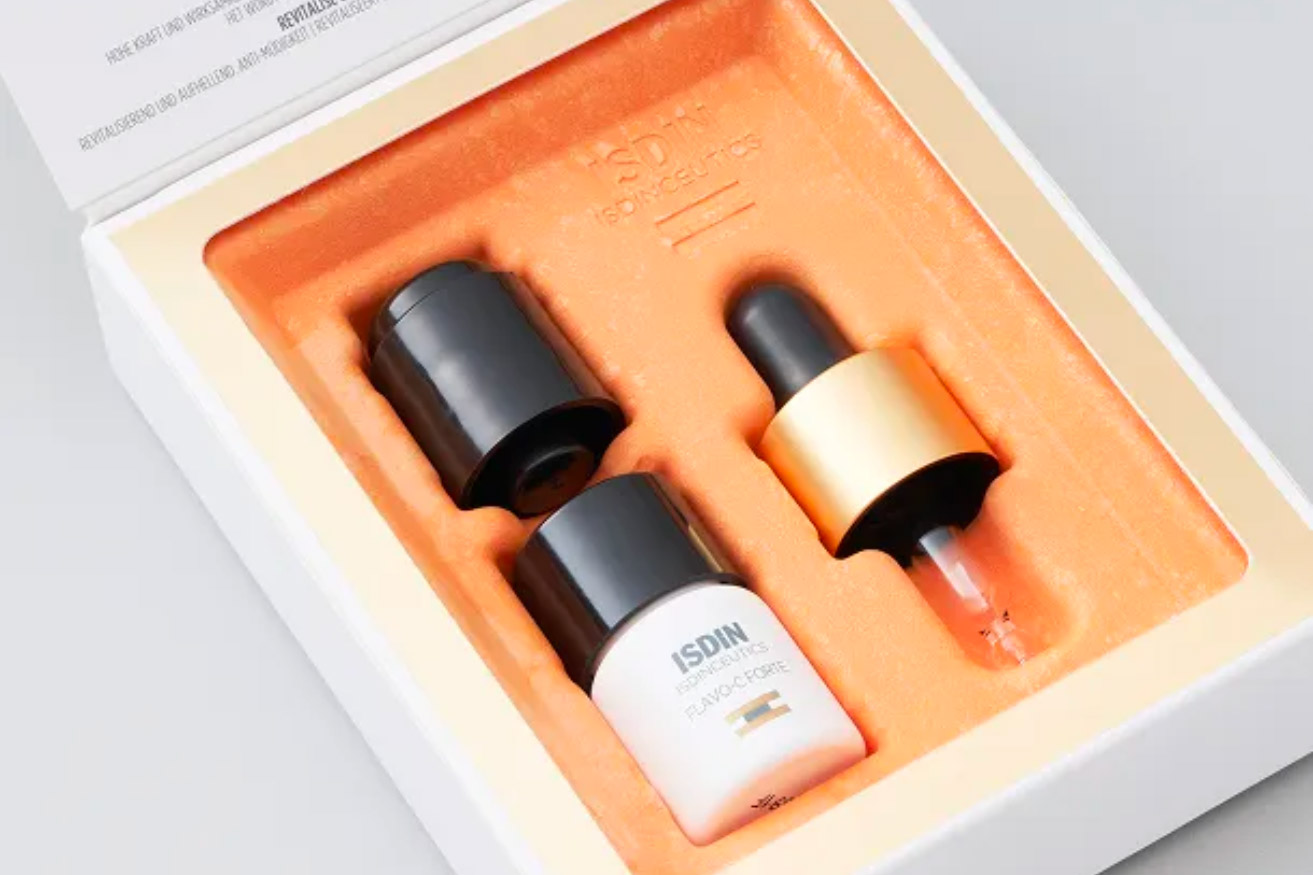
PaperFoam®, meanwhile, is positioned as a cushioning material for protective packaging. Its use cases include trays for cosmetic items or gift sets, where packaging must hold products securely while supporting a more premium and sustainable presentation.
Why low-dust performance matters
Dust generation is an often-overlooked issue in paper and fibre-based packaging. In cosmetics and healthcare, however, material cleanliness can be critical. Loose particles may affect product presentation, packaging perception and, in some cases, compatibility with more sensitive applications.
Nissha Europe reports that its Pulp-Injection and PaperFoam® solutions showed significantly fewer particles compared with conventional moulded fibre in internal dust comparison tests. The company notes that these results are based on internal testing and should be considered as reference values.
The test procedure involved rubbing specimens in a laminar flow cabinet and measuring particles using a particle counter, with particle sizes above 0.5 µm and equal to or above 1.0 µm considered.
While the data is not positioned as an external certification, it highlights a broader packaging trend: as fibre-based materials move into more demanding sectors, their performance is being evaluated beyond sustainability claims alone.
Fibre-based packaging moves into more technical territory
The development of low-dust, precise pulp-based packaging reflects the growing maturity of paper alternatives. For cosmetic brands, the challenge is no longer simply to replace plastic with paper. The real question is whether fibre-based materials can meet expectations around aesthetics, functionality, hygiene, protection and scalability.
This is especially important in premium cosmetics, where packaging is part of the product experience. A sustainable material must still feel refined, protect the product effectively and support the brand’s visual identity.
Nissha Europe’s approach suggests that the next phase of paper-based packaging will be increasingly technical. Design flexibility, cushioning performance and particle control are becoming part of the conversation, alongside recyclability and material reduction.
For cosmetics and healthcare packaging, this could make pulp-based solutions more competitive in applications where conventional moulded fibre has previously struggled to meet performance or aesthetic requirements.
Image Credits: Nissha Europe