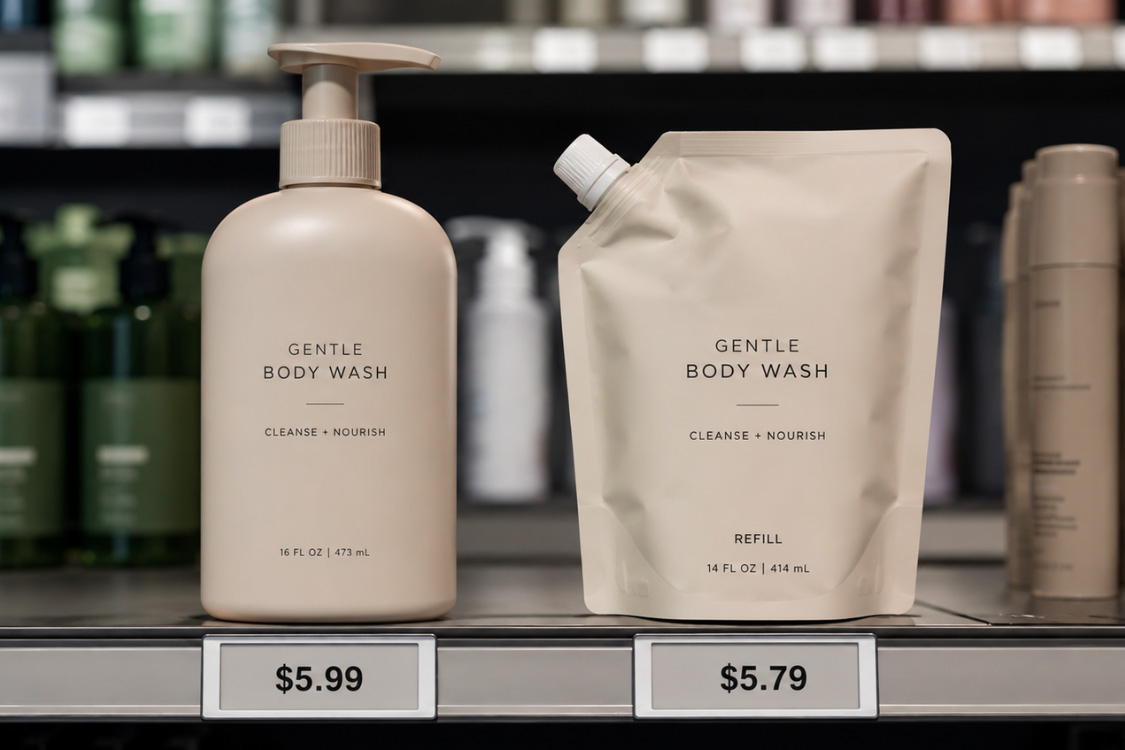
Refill packaging is often presented as one of the most intuitive answers to packaging waste. The logic seems simple: consumers buy the original product once, keep the primary container, and purchase a lighter refill pack when the product runs out. Less packaging, less material, less waste.
But there is another assumption attached to refill systems, and it may be just as important for adoption: consumers expect refills to cost less.
That expectation is not marginal. According to new consumer research published by Amcor, 86% of respondents expect refill products to cost less than the original packaged product, while 69% say they would buy more refills in the future if prices were lower. The research, conducted across six European countries in the beauty and personal care sector, also found that refill pouches are already familiar to many consumers, with 66% reporting that they had purchased a refill pouch within the last 12 months.
These figures highlight a central tension in the refill model. Consumers increasingly understand the environmental logic of refill packaging, but they also interpret it through a very practical lens. If the pack uses less material, why should it not be cheaper?
Consumers See Refill as a Price Promise
From the consumer’s point of view, refill packaging carries an implicit promise. It suggests that the user is paying for the product, not for a new bottle, jar or dispenser every time.
This perception is especially strong in categories such as personal care, home care and beauty, where the original pack often plays a visible role in the product experience. A shampoo bottle, handwash dispenser or skincare jar may be designed to remain in the bathroom for weeks or months. Once that container is already in use, the refill appears to be the more efficient and rational purchase.
The problem is that consumers rarely see the full cost structure behind a refill system. What they see is a smaller, lighter or simpler pack. What they expect is a lower price.
That expectation can become a barrier if the refill is priced too close to the original product, or in some cases even positioned at a premium. In such situations, the consumer may begin to question the value proposition. If refill packaging is supposed to reduce material use, but does not reduce the price, the model can feel less convincing.
This does not necessarily mean that refill packs must always be significantly cheaper. But it does mean that brands need to understand that price is part of the refill narrative. Sustainability alone may not be enough to change purchasing habits at scale.
Less Packaging Does Not Always Mean Lower Cost
The idea that less packaging should automatically mean lower prices is understandable, but it oversimplifies the economics of refill systems.
Material reduction is only one part of the equation. Refill packaging can involve additional development costs, new formats, adapted filling lines, different supply chain requirements and specific shelf strategies. Flexible refill pouches, for example, may reduce material weight compared with rigid packaging, but they still need to protect the product, preserve quality, prevent leakage and offer a convenient pouring experience.
In some cases, refill systems also require brands to design two packages instead of one: the durable original container and the refill format. These components need to work together as a system. The bottle must be easy to reuse, the refill must be easy to open and pour, and the entire experience must feel clean, practical and reliable.
There are also scale considerations. Conventional packaging formats benefit from established production infrastructure and high volumes. Refill systems, especially when they are still developing within a category, may not yet have the same efficiencies. Until volumes increase, the cost advantage expected by consumers may be harder to deliver.
Retail visibility adds another layer. A refill pack is not only a technical solution; it must also compete on shelf. It needs to be easy to identify, easy to match with the original product and easy to understand. If the consumer has to search for it, compare formats or wonder whether it fits the product they already own, the refill proposition becomes weaker.
This is why the refill discussion cannot be reduced to packaging weight alone. Less material can support a more efficient system, but it does not automatically remove the costs involved in making that system work.
Sustainability Still Matters, But It Is Not Enough
The same research shows that sustainability remains a strong driver of consumer interest. 81% of respondents said they are more likely to buy personal care refill pouches if they are recyclable, while 74% are more likely to purchase refills packaged in recycled plastic.
This is important because it shows that consumers are not only looking for lower prices. They want refill packaging to make sense environmentally as well. A refill pack that is cheaper but difficult to recycle may not fully meet expectations. At the same time, a refill pack that is recyclable but not convenient or affordable may struggle to become a repeated habit.
This is where the refill model becomes more complex. A successful refill system must deliver across several dimensions at once: lower material use, credible end-of-life options, practical functionality, strong product protection and a price that feels fair.
If one of these elements is missing, the consumer experience can become fragile. A refill pouch that spills during use, a pack that is difficult to recycle, or a price that feels too high can all weaken the perceived value of the system.
For refill packaging to move beyond a niche or occasional purchase, it needs to be designed not only as a sustainable alternative, but as a better purchasing experience.
The Real Refill Challenge Is Trust
Refill packaging depends on trust. Consumers need to trust that the system is actually reducing waste, that the product quality is the same, that the refill is easy to use and that the price reflects the reduced packaging proposition.
When that trust is missing, refill risks being perceived as another sustainability claim rather than a meaningful change in packaging behaviour.
This is particularly relevant in beauty and personal care, where packaging has traditionally carried strong emotional and brand value. Consumers may like the idea of reusing a premium bottle or jar, but they also need a clear reason to come back to the refill. That reason may be environmental, economic, functional or emotional. Ideally, it is all of these at once.
Price plays a critical role because it makes the value of refill immediately visible. A lower price can act as a simple and tangible signal that the consumer is being rewarded for reusing packaging. Without that signal, brands may need to work harder to explain why the refill still offers value.
In this sense, the refill paradox is not only about cost. It is about communication. Brands must show consumers what they are saving: material, emissions, waste, money or ideally a combination of these. If the benefit is not visible, the refill proposition becomes harder to understand.
Refill Must Make Sense at the Checkout
The future of refill packaging will not depend on sustainability claims alone. It will depend on whether refill systems can become easy, visible, reliable and economically attractive enough to fit into everyday purchasing behaviour.
Consumers are clearly open to the idea. Many have already tried refill pouches, and many say they would buy more if the price were lower. But the expectation is also clear: refill should not feel like a compromise.
For brands and packaging suppliers, the challenge is to design refill systems that work across the full value chain, from material selection and product protection to shelf placement and consumer use. For retailers, the opportunity lies in making refills easier to find and easier to choose. For consumers, the decision will often come down to a simple question: does this refill make sense compared with buying the original product again?
Less packaging may not always mean lower prices. But if refill packaging wants to become a mainstream habit, it must offer value that consumers can immediately recognise.