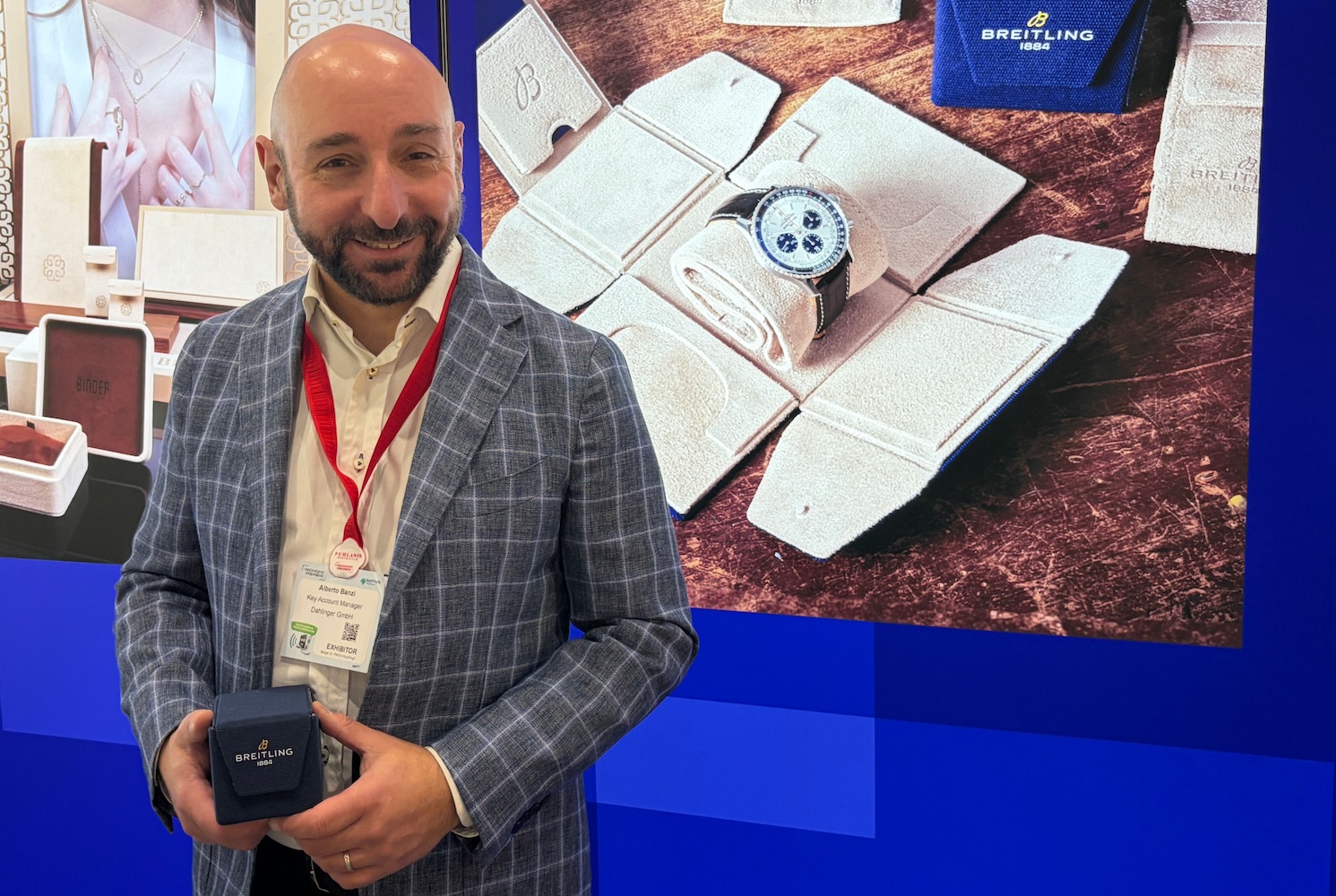
In high-end packaging, sustainability cannot be treated as a mere technical adjustment. It is certainly a matter of materials, but also of perception, brand consistency and the ability to preserve the purchasing experience that, in the luxury sector, remains an integral part of the product’s value. It is around this balance that Dahlinger, a historic company specialising in packaging for jewellery, watches and lifestyle products, is shaping its response to the regulatory changes introduced by the PPWR.
For Alberto Banzi, key account manager, the starting point is clear: “The PPWR did not come out of nowhere. The industry had known for years that a regulation was coming.” The requirements introduced by the new regulatory framework, he adds, are understandable: “No harmful bisphenols, no heavy metals: these are indications that move in the right direction.” According to Banzi, Dahlinger did not wait for the new rules to come into force before addressing these issues. “We had been thinking about this for some time, because the change was already written into the market before it was written into the regulation.”
For a company like Dahlinger, this transition is particularly significant. Luxury packaging is never just a container: it protects, presents, communicates and is often kept by the consumer. In the world of jewellery and watchmaking, a case or box accompanies the product over time, reinforcing the memory of the purchase and contributing to the perception of value. The challenge, therefore, is not simply to “make sustainable packaging”, but to do so without betraying the brand’s language or reducing the quality of the experience.
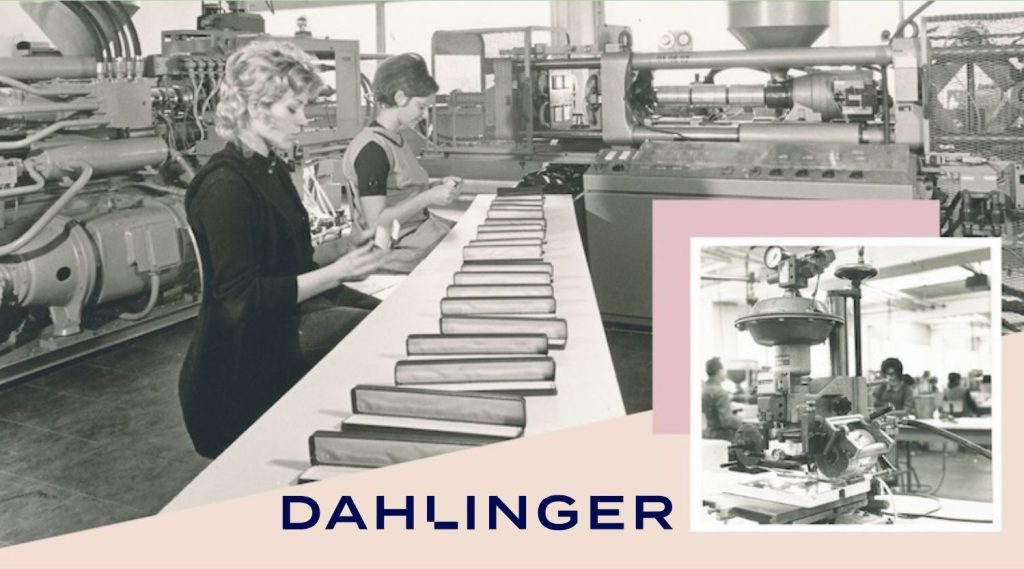
A history spanning more than 150 years
Founded in 1871, Dahlinger is today an internationally recognised name in packaging for luxury and lifestyle products. Originally established as a traditional manufacturer of jewellery cases, the company has gradually expanded its scope, becoming a partner for jewellery, watchmaking and other premium brands.
“Dahlinger has existed for 155 years and is very well known in the German-speaking world,” Banzi explains. “For a long time, our work was mainly connected to retail, but over the last two decades the custom-made side of the business has grown significantly.” This shift marked an important evolution: from collections and standard solutions for the point of sale to projects built around the identity of the brand, its customers and the type of experience the packaging is meant to create.
This is precisely where the company’s history meets the present. A manufacturer with such deep roots is called upon to show that tradition and innovation are not opposing forces. On the contrary, continuity becomes a competitive advantage when it allows a company to read market changes clearly and address them before they turn into emergencies.
Luxury changes, and packaging follows
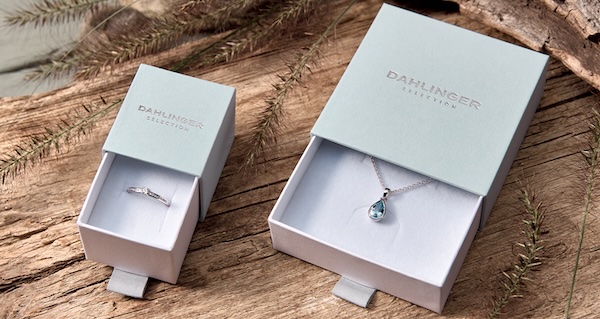
In Banzi’s account, the evolution of Dahlinger’s packaging is closely intertwined with the evolution of the jewellery market. Over the last twenty years, the sector has gone through very different phases. “The jewellery market changes almost every five years,” he observes. “At the beginning, around twenty years ago, we saw a decline in interest among younger generations: the concept of luxury had shifted from jewellery to smartphones and other electronic devices.”
Then came brands capable of redefining the approach to jewellery, making it more everyday, less formal and closer to people’s daily lives. “Some brands revolutionised the way they approached the market,” Banzi explains. “They created the idea of jewellery to be lived: less demanding, made to be worn every day and not only on special occasions.” This transformation also changed expectations around packaging: it had to become more flexible, more contemporary and closer to the language of the consumer.
Today, according to Banzi, there is renewed attention for valuable jewellery, roughly in the €1,500 to €5,000 range. “Interest has returned for a piece of jewellery that lasts, also as an investment,” he says. “In uncertain times, the idea of buying something that can be kept or given to one’s children gains renewed meaning.” Watchmaking has followed a different trajectory, more closely linked to design and iconic objects, with moments of strong popularity already in the 1990s. “Just think of the queues outside Swatch stores for the latest model,” Banzi recalls. “Then, in that sector too, attention shifted towards smart devices, but today interest in the watch as an object of value has returned.”
Packaging has followed this journey in parallel. If consumers are once again looking for durable, authentic and meaningful objects, the packaging must also respond to this expectation. It must communicate value, but also responsibility. It must be elegant, but not excessive. It must be memorable, but not inconsistent with contemporary environmental awareness.
Sustainability, without shortcuts
The new perception of luxury also passes through packaging sustainability, but only if it is integrated credibly into the brand’s reality. “Packaging sustainability is becoming increasingly important,” Banzi underlines, “but it has to be done well and brought into the real world of the brand.” For Dahlinger, this does not mean applying a single formula. Paper, cardboard, coated or lacquered MDF wood, plastic, recycled PET for internal lining fabrics, paper ribbons with a textile appearance: the work lies in selecting and combining materials according to the project, the function of the pack and the brand promise.
“We use paper, cardboard, coated or lacquered MDF wood, but also plastic and recycled PET,” Banzi explains. “Plastic can be used in a sustainable and conscious way, if it is chosen and designed correctly.” Even apparently secondary details can contribute to the overall result. “We have paper ribbons that look like fabric. It is an example of how you can work on perception without giving up a more responsible direction.”
Banzi insists on one point: sustainability does not automatically mean eliminating one material or replacing it with another for ideological reasons. “What does sustainability mean? Recycled? Recyclable? Reusable?” he asks. “We need to avoid prejudices and assess each project as a whole.” From this perspective, the question is not whether a material is good or bad in absolute terms, but whether it is consistent with the product’s life cycle, with the function of the packaging and with the identity of the brand.
In this sense, the PPWR becomes an important framework, but not the only driver of change. “In Northern Europe, especially in Scandinavia, this awareness has already been present for some time,” Banzi observes. “In Central and Southern Europe, it is now accelerating, also thanks to a new generation of managers.” These are, in his view, professionals now around 40 to 45 years old, who grew up with a greater awareness of environmental issues and are more inclined to integrate them into business decisions.
When packaging communicates value: the Breitling pack
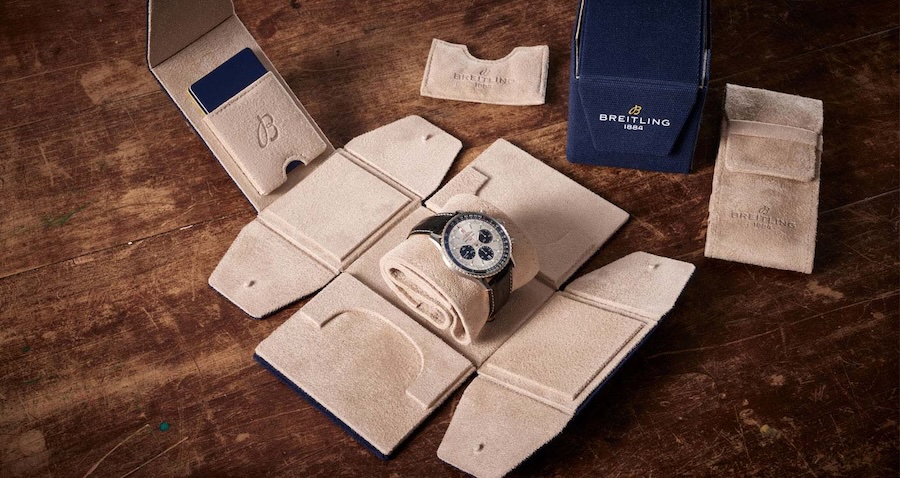
One example mentioned by Banzi is the project developed together with Breitling, which shows how packaging can become part of a product’s storytelling while also contributing to greater efficiency. “The Breitling pack is a perfect example of how packaging can convey value to the final consumer,” he explains. “It is not just a box: it becomes a fundamental part of the brand narrative.”
The project was also designed to optimise logistics. “It was developed to be shipped flat,” Banzi says, “in order to reduce space and optimize transport.” This is a technical detail, but one with important consequences: less volume occupied, more efficient handling and a lower impact linked to distribution. The approach is particularly interesting because it shows that sustainability is not only about the material the consumer sees. Sometimes the difference lies in the structure, in the way the packaging is assembled, stored and shipped.
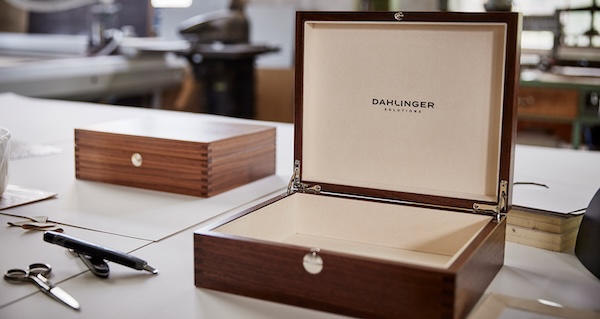
The same principle guides work on packaging traditionally considered elegant but complex from an environmental standpoint. Banzi mentions the case of a lacquered wooden box with plastic components. “It is an elegant box, one that the consumer usually keeps and does not immediately dispose of. But production could still be improved from a sustainability perspective.” Dahlinger intervened on several levels: FSC wood, internal lining in recycled PET and a solvent-free water-based lacquer.
This last step is particularly significant. “The issue was the external lacquer,” Banzi explains. “A few years ago, water-based formulas did not hold up: they were weak and did not perform like traditional ones.” Today, however, technical evolution makes it possible to achieve a comparable result. “Water-based lacquering has now evolved,” he adds. “The result is the same as with traditional lacquering, but without solvents.” For luxury packaging, this is a decisive point: sustainability becomes acceptable for the brand only when it does not compromise the aesthetic and tactile quality of the object.
The future of premium packaging
The lesson emerging from Dahlinger’s experience is that premium packaging cannot merely chase regulation. It must anticipate it, interpret it and turn it into a design opportunity. The PPWR requires the industry to pay closer attention to materials, substances, recyclability and impact reduction. But for luxury brands, the real challenge is broader: preserving the symbolic value of the pack while making it more responsible.
“It is not enough to say that packaging is sustainable,” Banzi concludes. “It has to work for that brand, for that product and for that consumer.” Poorly executed sustainable packaging risks appearing cheap, inconsistent or simply not credible. Well-designed sustainable packaging, on the other hand, can strengthen the relationship with the consumer, express the evolution of the brand and demonstrate that contemporary luxury can no longer be separated from awareness.
Dahlinger seems to be moving precisely in this direction: not a break with the past, but a progressive evolution. A transformation made of more responsible materials, more efficient logistics solutions, supply chain awareness and the ability to preserve that perceived quality which, in high-end packaging, remains essential.
Ultimately, the question is no longer whether luxury packaging needs to change. The question is how to change without losing its identity. And this is where historic companies like Dahlinger can play an important role: showing that sustainability, technology and beauty can coexist, provided they are approached as parts of the same project.
All the pictures of this article are courtesy of Dahlinger