
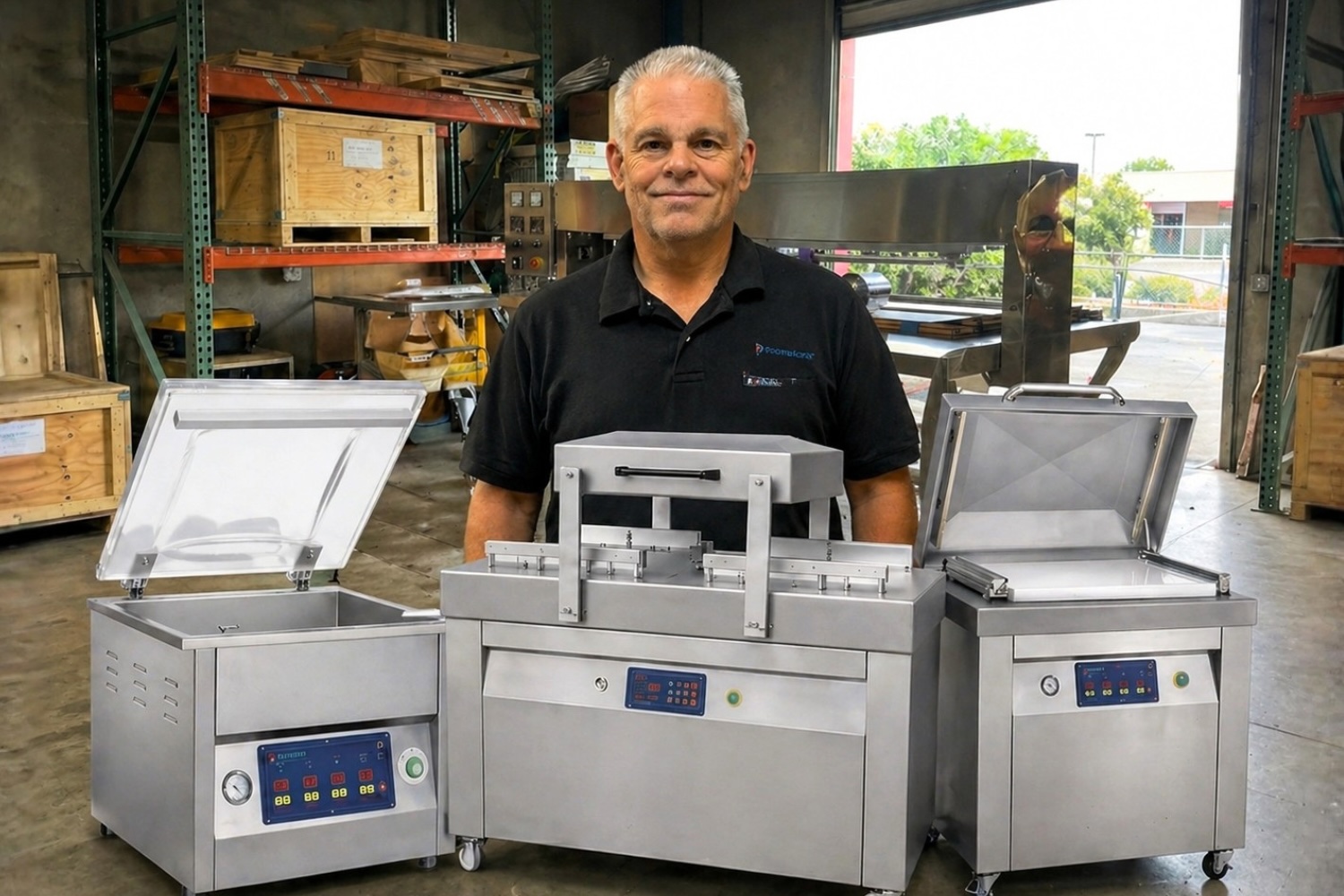
As vacuum packaging evolves beyond its traditional industrial role, automation, efficiency and accessibility are becoming the key drivers of growth. At the forefront of this period of change is Promarksvac, which has for years been dedicated to designing and manufacturing various types of vacuum packaging machines, and which, over the course of its long history, has seen the market evolve, moving away from large companies and knocking on the doors of our homes.
We interviewed Rick Hurd, Services Manager at Promarksvac, who gave us a very clear insight into this evolution, explaining how demand is changing across large-scale operations, new application sectors and the consumer market, where more affordable systems are helping bring commercial-grade vacuum packaging to a wider user base.
Promarksvac has built its reputation in industrial vacuum packaging. How do you see the technology evolving today in large-scale food processing environments, and what are the main performance priorities for b2b clients now, compared with a few years ago?
“We can clearly see the evolution of our business. Promarksvac is always a step ahead in our vision of the future. The present for us was planned years ago and we are researching and investing now in our future. Inquiries from our customers tell us a lot about the current and future needs. So, we must be listening. One such need is automation to improve productivity and more advanced technology to accommodate more sophisticated applications like medical, military, electronics and aerospace”.
What convinced you that this was the right moment to expand beyond traditional industrial applications and make vacuum packaging more accessible to a wider user base?
“Customer inquiries and good research tell us a lot and we are prepared to flex in any direction the industry demands. We have moved forward in production of a new economical line of equipment “Introvac”, built in our new facility, to offer a high-quality product at an affordable price. Now even the homeowner, fisherman and hunter can afford a commercial vacuum packaging machine and not have to settle for a poorly made, cheap import, that offers no support or parts.”
In your opinion, which target group will grow the most in the coming years: small food businesses, foodservice operators, specialty retailers, or end users at home?
“In my opinion, end users at home offer the greatest growth. With food prices rising faster than incomes, it is becoming more than ever necessary to buy in bulk and freeze products to save money. Those that fish and hunt are moving away from sport and more so feeding their families. So, having a vacuum packaging machine at home is becoming a necessity. Our “Introvac “line is ready to lead the way”.
Industrial users typically focus on throughput, consistency and compliance. Smaller operators or first-time users often look for simplicity and affordability. How do you balance these very different expectations in product development?
“To simply have equipment for every need and application. And when something new comes our way, we love a challenge!”
What are the biggest barriers that still slow down the adoption of vacuum packaging machines outside large industrial settings, and what needs to happen for this technology to become more mainstream?
“Cost has always been a large barrier in business outside of large commercial facilities. Today with social media, the word is getting out that a lower cost alternative is now available and practical.”
Beyond shelf life extension, how is vacuum packaging changing the wider production process today in areas such as food waste reduction, product quality management, logistics and operational efficiency?
“Definitely, shelf life of a food product is the highest priority in vacuum packaging. But over the past few years we have seen industries like electronics, medical and shipping logistics taking a big step towards vacuum packaging. Certain class standards in electronics require vacuum sealed packaging and as for shipping, I think most of us have seen products delivered to us that are vacuum packaged to reduce the size of the product.”
Looking ahead, what do you expect will shape the next phase of growth in vacuum packaging most: automation, smarter controls, ease of use, material compatibility, sustainability requirements, or changing consumer habits?
“I think automation will be the largest advancement in our industry. With wages rising, government regulation, insurance and overall operational cost skyrocketing, companies are looking for more cost saving options including staff reductions, investments in automation and AI.”
As packaging materials evolve, how are your vacuum packaging systems adapting to bio-based, recyclable or compostable films, and what does the industry still need to solve in terms of sealability, barrier performance and machine efficiency?
“Machine efficiency is an ongoing challenge. “Busch” vacuum pumps are a great partner of ours and they have recently introduced more efficient vacuum pumps that we use. Our customers always like to hear about lower operating costs. Efficiency also relies on the customer having the right machine for the right application. This is a standard we use every day”.
A challenge, indeed. But that really does present itself as an opportunity: the global food vacuum machine market is expected to grow from USD 16.78 billion in 2026 to USD 25.30 billion by 2034, representing a compound annual growth rate (CAGR) of 5.30%. (source: Fortune Business Insights) – chamber vacuum machines are the largest product segment, accounted for 33.37% of the market in 2026, (industrial end users are at 57.27%). Handheld vacuum sealers are expected to experience the fastest growth.
However, this is not just about keeping pace with that evolution: it’s about shaping it through automation, application-driven design and solutions tailored to a broader and more diverse market. From industrial productivity to household food preservation, vacuum packaging is entering a new phase in which performance, affordability and adaptability increasingly go hand in hand. And the markets, as always, will have the final say.

