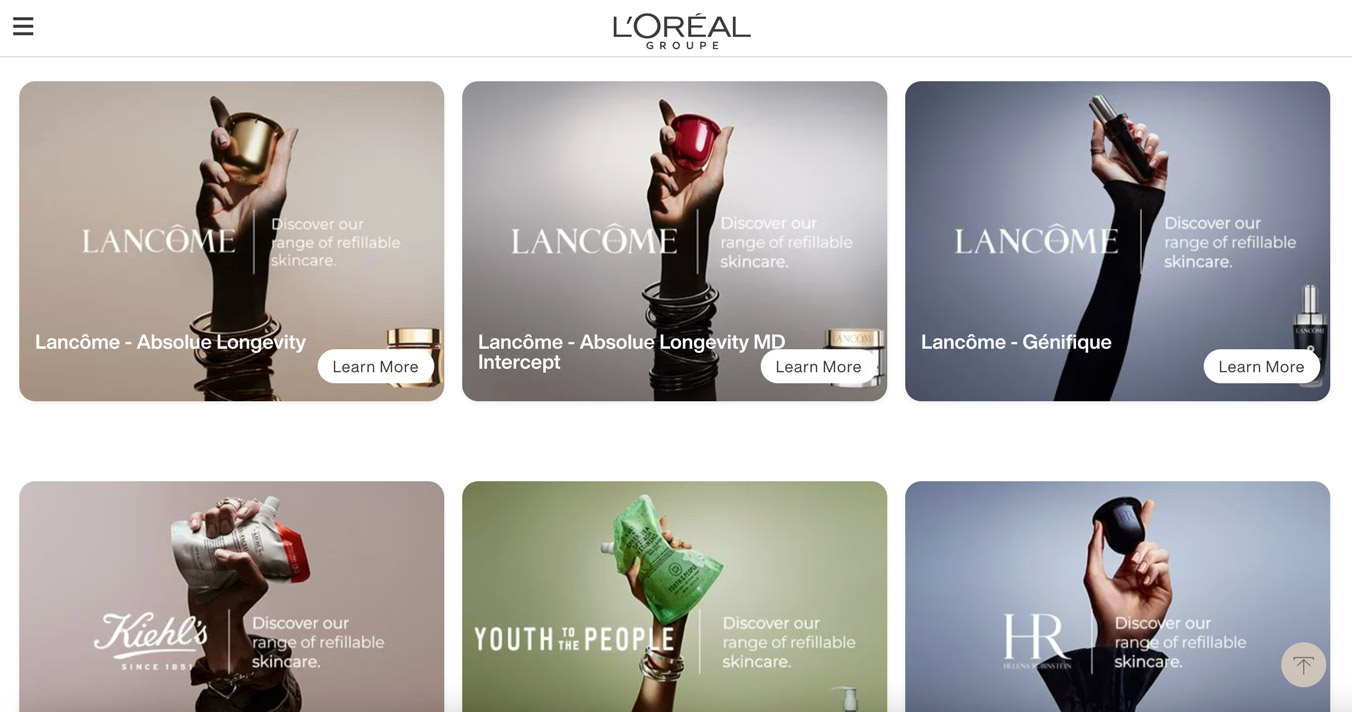
Refillable packaging has become one of the most visible directions in the beauty industry’s transition towards lower-impact formats. Yet its success depends on more than the technical possibility of refilling a bottle, jar or pouch. For refill to become meaningful at scale, consumers must be able to find it easily, understand its benefits and repeat the gesture often enough for it to become part of their purchasing routine.
This is the central message behind the third edition of L’Oréal’s #JoinTheRefillMovement campaign. The initiative, presented by the Group as its biggest campaign for refillable beauty so far, expands the refill message across brands, categories and price points, reinforcing the idea that refillable beauty cannot remain a niche option limited to premium fragrance or selective skincare.
For packaging, the campaign is relevant because it shows how refill is moving from a design feature to a wider commercial system. The challenge is no longer only to develop refillable formats, but to make them visible, desirable and accessible across different beauty categories. In this sense, the refill movement is becoming less about a single pack and more about the infrastructure that allows reuse to become a repeated consumer behaviour.
Refill Moves Beyond a Premium Beauty Niche
For years, refillable beauty has been strongly associated with prestige fragrance and luxury skincare, where durable primary packs, premium rituals and higher price points helped make the refill gesture more intuitive. L’Oréal’s latest campaign suggests that this positioning is widening. The 2026 edition involves all four of the Group’s divisions: Luxe, Consumer Products, Professional Products and Dermatological Beauty.
This broader scope is important because refill will only become mainstream if it works across different types of beauty consumption. A refillable fragrance bottle and a refill pouch for shampoo do not answer the same consumer need, but both are part of the same shift: reducing the need to repurchase a full primary pack every time the product runs out.
In the Luxe division, the campaign continues to build on refillable fragrance and skincare formats, with additional brands and hero products joining the movement. In Consumer Products, the inclusion of more accessible haircare products points to a different kind of refill opportunity, one linked to everyday purchasing rather than occasional luxury consumption. Professional Products and Dermatological Beauty also add weight to the strategy, showing that refill is being positioned across salon, skincare and dermocosmetic categories as well as prestige beauty.
This matters for the packaging industry because refillable systems need category-specific solutions. A refill strategy for fragrance may rely on keeping the original glass bottle and purchasing a larger refill format, while haircare and skincare may depend more on pouches, lighter containers or simplified secondary packs. The common objective is material reduction, but the packaging logic changes according to the product, the channel and the consumer habit behind each category.
The Refill Challenge Is Also a Retail Challenge
One of the most difficult questions for refillable packaging is not whether it can reduce material use in theory, but whether consumers will actually adopt it in practice. A refill system that is not visible at shelf, difficult to understand or unavailable when the consumer needs it risks remaining a sustainability claim rather than becoming a real circular behaviour.
This is why L’Oréal’s campaign is interesting from a packaging perspective. It presents refill not only as a product feature, but as a movement that needs repetition, education and accessibility. The more refillable options appear across different brands, price points and retail environments, the more familiar the gesture becomes. In other words, refill needs to be treated as a consumer habit, not as a special action reserved for highly engaged shoppers.
For retailers and brands, this creates new requirements. Refillable formats must be clearly displayed, easy to compare with standard packs and supported by simple communication. Consumers need to know what they are saving, how the refill works and why it makes sense to keep the original packaging instead of buying a new one. Without that clarity, even well-designed refill systems may struggle to move beyond early adopters.
The campaign also highlights an important point for the beauty sector: convenience remains essential. A refillable product cannot ask consumers to compromise too much on usability, product protection or brand experience. In beauty, packaging is closely tied to desirability, identity and routine. Refill must therefore reduce material impact without making the experience feel less premium, less hygienic or less practical.
Clear Packaging Claims Help Consumers Understand the Impact
Another relevant element of the campaign is the use of product-specific impact claims. Instead of relying only on broad sustainability language, L’Oréal presents refill examples with concrete reductions in packaging materials such as glass, plastic, metal or cardboard compared with the repurchase of standard formats.
This approach is particularly useful because refill benefits are not always obvious to consumers. A refill pouch, for example, may still be made of plastic, while a heavy glass jar may look more durable and premium. Without clear information, it can be difficult for consumers to understand where the material savings actually occur. Product-level claims help make the environmental logic of refill more visible.
For packaging communication, this is an important shift. As sustainability claims come under greater scrutiny, brands need to move away from generic statements and provide clearer, more specific explanations. Refill is a good example of this need because the impact depends on the comparison being made: the size of the refill, the number of uses, the material composition of the original pack and the format that would otherwise have been repurchased.
At the same time, transparency will be essential. If refillable beauty is to become a trusted category, brands will need to explain the assumptions behind savings claims and ensure that consumers understand how to use refill systems correctly. The packaging benefit is only fully realised when the original container is kept and refilled as intended.
L’Oréal’s third #JoinTheRefillMovement campaign shows that refillable beauty is entering a more mature phase. The conversation is moving beyond whether refillable packaging can exist and towards whether it can become normal, visible and repeatable across everyday beauty routines. For the packaging industry, this is a crucial distinction.
The future of refill will not depend only on more refillable packs, but on the ability to build systems around them: retail visibility, simple instructions, trusted claims, convenient formats and a clear reason for consumers to come back to the refill option again. If refillable beauty is to move from sustainability gesture to consumer habit, packaging design will have to work together with behaviour, communication and distribution.
Image Credits: L’Oréal Group