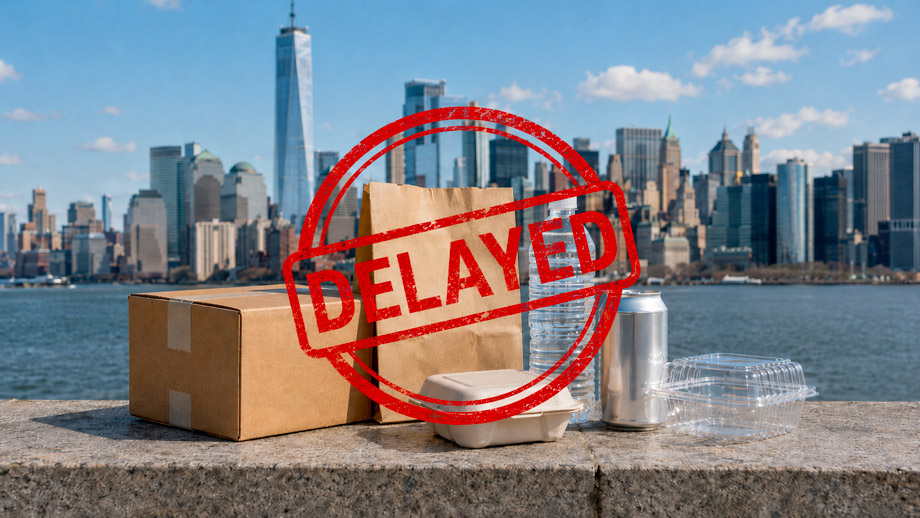
At first glance, New York’s latest packaging EPR setback seems difficult to explain.
Across the United States, extended producer responsibility (EPR) is steadily moving from legislation to implementation. States such as California, Oregon, Colorado and Minnesota have already adopted packaging EPR frameworks, while companies are increasingly preparing for reporting obligations, compliance requirements and producer fees.
Yet New York’s Packaging Reduction and Recycling Infrastructure Act failed to advance once again in 2026, marking the third consecutive year in which lawmakers were unable to move the proposal forward.
The question is not simply why the bill failed. The more interesting question is why packaging EPR is progressing in some states while New York continues to face political and industry resistance.
The answer may reveal an important divide in how packaging regulation is evolving across the United States.
New York’s proposal goes beyond traditional EPR
One reason the New York bill remains controversial is that it extends far beyond the traditional concept of producer responsibility.
Most packaging EPR programs are designed around a relatively straightforward principle: producers contribute financially to the collection, sorting and recycling of packaging waste. The goal is to shift part of the burden away from municipalities while creating incentives for more recyclable packaging.
New York’s proposal, however, combines several objectives within a single legislative framework.
Alongside EPR requirements, the bill includes packaging reduction targets, restrictions on certain chemicals, recycled-content provisions and broader measures intended to reshape packaging systems over time.
Supporters argue that this approach addresses the root causes of packaging waste rather than simply improving recycling infrastructure.
Critics, however, contend that the proposal introduces a level of complexity that creates uncertainty for producers, retailers and packaging manufacturers.
As a result, debates around the bill have often extended beyond EPR itself and into broader discussions about packaging design, product availability and compliance costs.
Other states’ gradual approach to EPR framework
The contrast with states such as California, Oregon and Colorado is particularly striking.
While each state has developed its own EPR framework, most have focused initially on creating mechanisms to fund and improve recycling systems rather than introducing multiple packaging reforms simultaneously.
This more gradual approach has generally attracted broader political support and allowed implementation efforts to move forward more quickly.
In many cases, the conversation has centred on how producers should contribute to waste management costs and how recycling performance can be improved, rather than on broader questions about packaging reduction or material restrictions.
The result is that several states are now entering implementation phases, while New York continues to debate the scope and structure of its proposed legislation.
This does not necessarily mean New York’s objectives are more ambitious than those of other states. Rather, it highlights how the pace and breadth of regulatory change can significantly influence political feasibility.
What the setback means for U.S. packaging regulation
The failure of New York’s bill should not be interpreted as a sign that packaging EPR is losing momentum in the United States. If anything, the opposite appears to be true.
Across North America, packaging regulation is becoming increasingly operational. Companies are investing in compliance systems, improving packaging data management and preparing for a future in which packaging accountability plays a much larger role in business decision-making.
What New York’s experience demonstrates is that a new debate is emerging around the future direction of packaging policy. Should regulation focus primarily on financing recycling infrastructure and improving material recovery? Or should it also be used as a tool to accelerate packaging reduction, material substitution and broader environmental objectives?
The answer remains far from settled.
A debate that is far from over
Although the Packaging Reduction and Recycling Infrastructure Act did not advance in 2026, few observers expect the conversation to disappear.
Packaging waste remains a growing environmental concern, and pressure on states to modernise recycling systems continues to increase.
Meanwhile, EPR programs in other parts of the country are moving from legislative frameworks to practical implementation, providing real-world examples that policymakers can evaluate in the years ahead.
For the packaging industry, the significance of New York’s latest setback may therefore lie less in the bill’s failure itself and more in the questions it raises.
The debate is no longer about whether producer responsibility will play a role in the future of U.S. packaging regulation. Increasingly, the debate is about how far that responsibility should extend.