
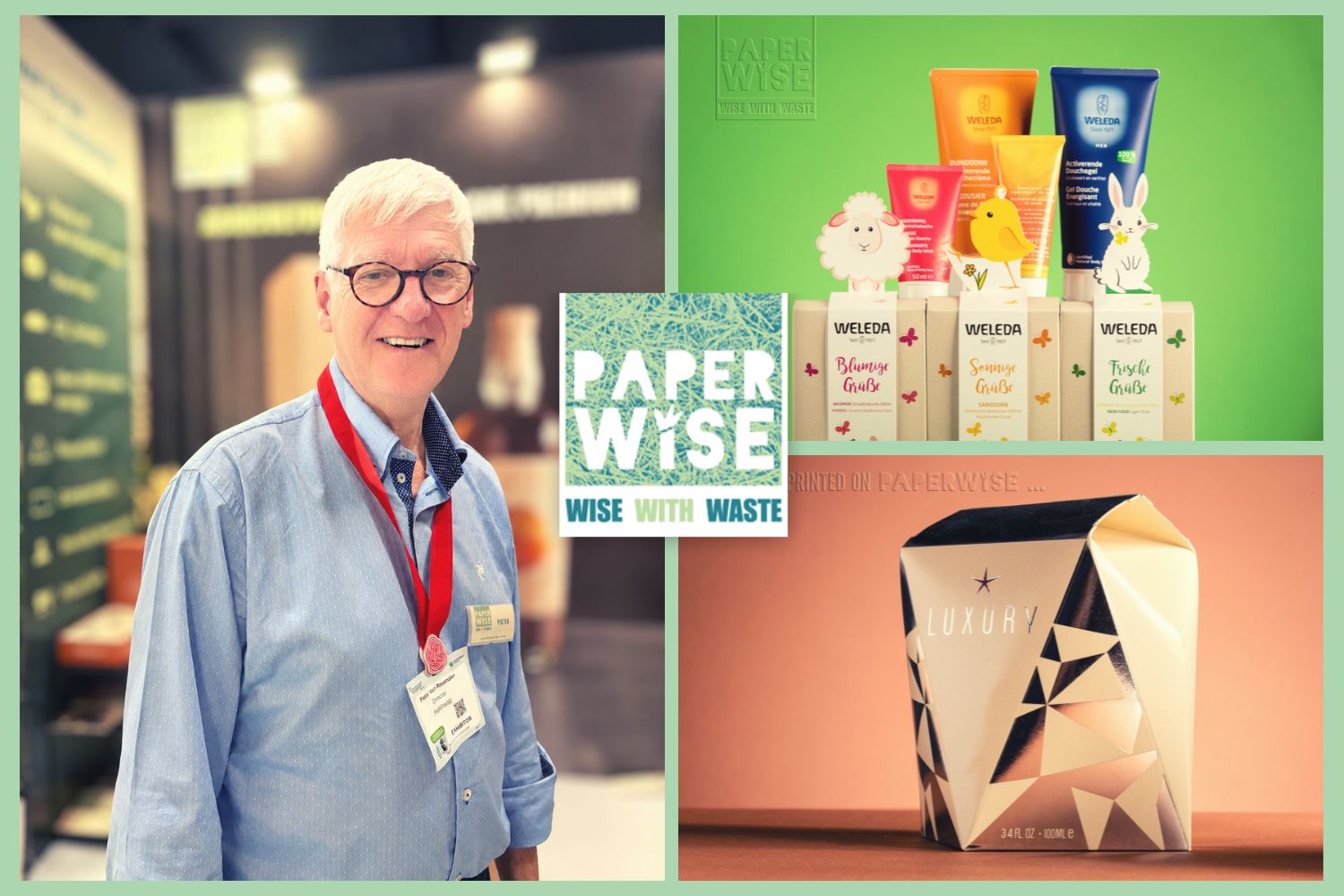
For Peter van Rosmalen, founder of PaperWise, sustainable packaging is not a matter of small percentages or “cosmetic” improvements. It is a decision to challenge the supply chain, question habits, and take responsibility for change.
There is a sentence that captures Peter van Rosmalen’s approach to sustainability better than any corporate manifesto: “You can’t change the world with five percent.”
He does not say it dismissively. He knows that every improvement can matter. “5% is better than nothing,” he acknowledges. “It can be a good start. But I go for 100%, whenever it’s possible. And if it’s not, I try to make it possible!”. In other words: incremental change is not enough when the environmental challenge itself is systemic.
“We use only a small part of what we grow as food – ” he explains- “Let’s say, 20%. The rest is often considered and treated as waste. But if we will need more food in the future, we will also have more agricultural residue. Why should we grow a tree for a paper cup that is used for twenty minutes?”
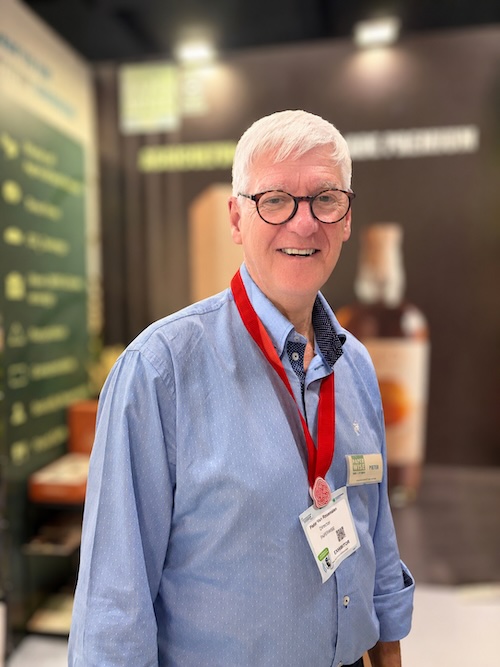
PaperWise is a company built around paper and board made from agricultural waste. It has recently celebrated 10 years. Not a simple material innovation, but a different way of looking at resources. Where the paper industry traditionally begins with wood or recycled fibres, PaperWise begins with what remains after the harvest: stems, leaves and other plant residues that are left over once food has been taken from agricultural crops. For van Rosmalen, this is not a waste: it is an overlooked raw material. The answer is clear: sustainability does not start by redesigning a product, it starts by redesigning the logic of the entire supply chain. Of course, there is a cost. But van Rosmalen says: “I did not start PaperWise for the money. That has never been my drive. My drive is Change, showing the world that things can be done differently.”
The path to entrepreneurship
Before founding PaperWise, van Rosmalen worked in a company that spoke frequently about sustainability. But in his view, there was a significant gap between corporate communication and action.
“The company I used to work for talked a lot about sustainability but did very little” he recalls. “One day, my granddaughter, a child at that time, asked me: ‘Grandad, if you use all our resources, what is gonna be left for us?’. That question stayed with me. Eventually, it became a decision”.
On January 1st, 2013, van Rosmalen left his previous path and started his own company: PaperWise. It took two years to develop the product and bring the idea into a workable industrial reality. The first challenge was not demand, but supply. Paper mills were used to working with wood pulp and recycled paper. Agricultural waste did not fit comfortably into the existing model.
“No paper mill was interested,” he says. “They were focused on recycled fibres and wood. When we talked about agricultural waste, they were willing to test maybe 5 or 6%. But that was not the idea.”
For van Rosmalen, adding a symbolic percentage of agricultural residue to conventional paper was not enough. “It might have been good for product communication strategies, but not if you aim to change the system. Let’s be clear: we don’t talk about what other companies do, and I don’t want to accuse anyone of greenwashing,” he says. “But we have our ideas. If you grind tomato stems, shells or other residues and add 20 or 30% to regular paper, that does not automatically make the product compostable or biodegradable. In some cases, it can even compromise paper recyclability or at least make it more difficult.”
This is why PaperWise chose a more radical path: focusing on paper and board made from agricultural waste, with a strong preference for high percentages; where possible, up to 100%.
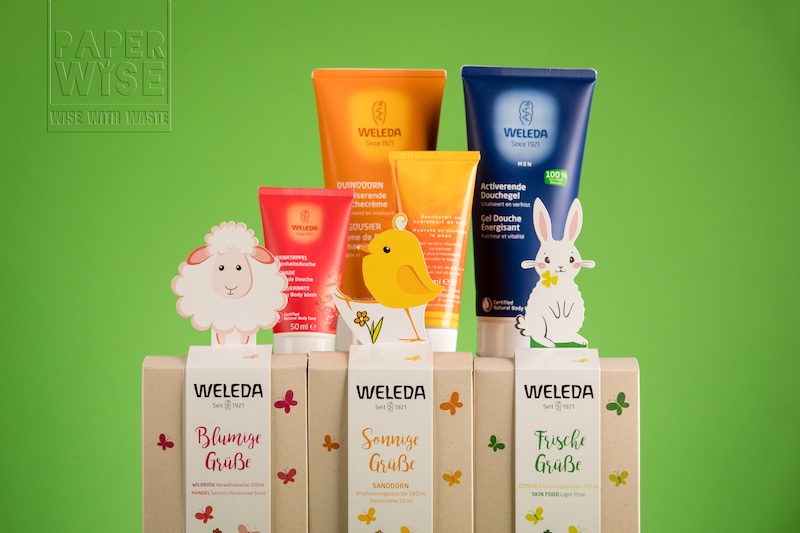
The strength to remain consistent with packaging sustainability
In packaging, compromise is often presented as pragmatism. Brands want sustainable materials, but they also want the same look, the same surface, the same price and the same habits. For van Rosmalen, this is one of the most difficult barriers to real change.
“Sustainability requires courage,” he says. “You have to dare. If the market only asks for materials that look exactly like what already exists, change becomes very slow.”
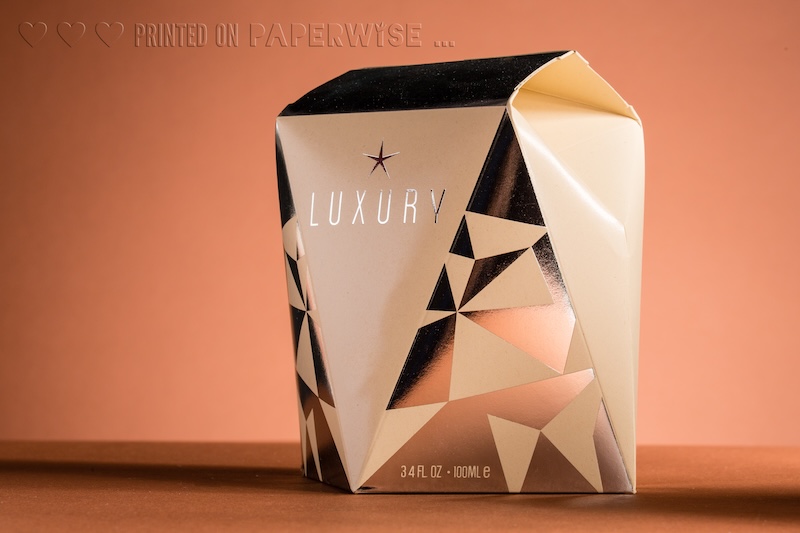
The issue is especially visible in premium packaging. Luxury has long been associated with deep black, metallic finishes, shiny surfaces, white papers and visual perfection. Natural materials are often perceived as less refined, even when they communicate authenticity and environmental responsibility more directly.
“Black, gold and silver catch people’s eyes,” van Rosmalen says. “Our packaging is not shiny. The natural colour may not be perceived as luxury in the same way as we used to intend it.”
He is realistic. A brand built around a consolidated visual identity will not change overnight. But habits are not laws of nature. “When I ask the reason behind some decisions in packaging design, the answer I often get is: because we have always done it that way.” Do we really have to settle for that? “I mean: do we really need paper to be bright-white? Even if a more natural and sustainable color is light enough to ensure perfect readability? Maybe customers will drive the change: new generations are more willing to question conventions, including visual ones. They are more likely to accept packaging that looks natural because it is natural. And brands, sooner or later, will follow the direction of demand. Change may not happen tomorrow, but step by step, I hope PaperWise can contribute to change a few things.”
A packaging partner: more a consultant than a supplier
Over the years, PaperWise has seen its materials used across a wide range of applications: carrier bags, copy paper, printing, boxes, office paper, notebooks and different types of packaging. In some cases, the company acts almost like a consultancy, helping customers understand which material choices are truly coherent with their sustainability ambitions.
“Sometimes we feel more like a consultancy agency than a supplier,” van Rosmalen says. “But we like to guide our customers. Sustainability is not only about choosing a material; it is about understanding the consequences of that choice.”
This point is particularly important in a regulatory environment that is pushing packaging companies to rethink recyclability, compostability, material reduction and circularity. PaperWise positions itself as naturally aligned with these discussions because its material is based on a secondary raw material: agricultural residues that become available every year as part of food production.
“We are naturally born PPWR-compliant,” van Rosmalen says. “Our materials have been tested in Germany, and we also test for food contact. We can support customers in making the right decisions for their products.”
That guidance also includes saying no. Not every combination of materials improves sustainability. Not every bio-based solution is recyclable with paper. Not every apparently “green” choice performs well at the end of product-life.
“You cannot simply ‘add some green’ and assume the result is better. There are good bioplastics, and there are interesting bio-based materials – he says – But there are limits to be aware of; maybe you look for a transparent material, and a certain bioplastic film is not transparent enough; another material cannot be recycled with paper… every application needs to be evaluated.”
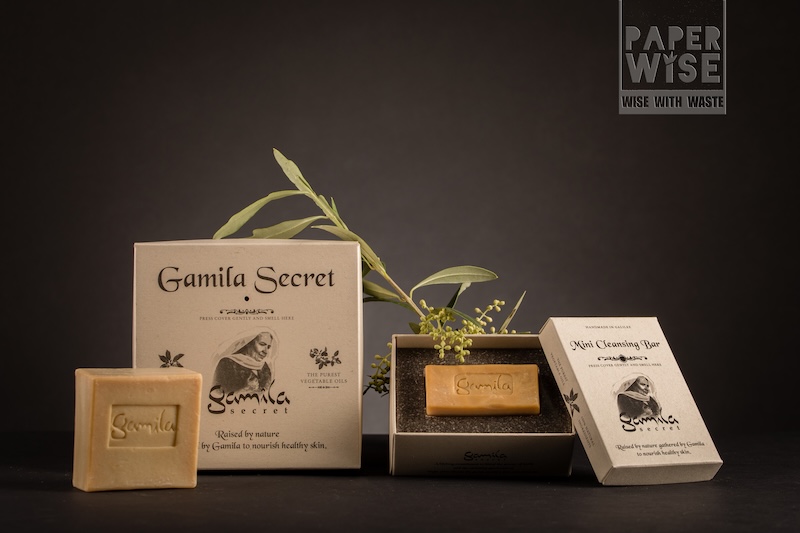
“Packaging innovation is a path full of challenges”
The PaperWise story is not one of uninterrupted success. Van Rosmalen is open about the mistakes, losses and difficult decisions that came with building the company.
“I failed sometimes,” he says. “I made difficult decisions, and some of them were completely wrong.”
One example was PaperWise White. The company had grown naturally with its unbleached, natural-looking material, but brands insisted on asking for a traditional, bright white. So,Van Rosmalen continues, “Years ago, we tried to respond to market demand and invested heavily in finding a sustainable way to achieve a shade as close as possible to classic bright white without using bleaching agents. It didn’t work out, despite the financial investment we have made in the project. But it’s still our own money: we don’t receive funding from outside investors”. The problem was that regular white paper was already everywhere — and much cheaper than its “eco” alternatives.
“We lost a lot of money,” he says. “It was not easy. But at least it was our money,” he says. “Not banks’ money, not investors’ money. We take full responsibility for the risks we face”.
That is why we always do tests, but customers have to pay for them. In that way, they also share the commitment.” This also explains why PaperWise is careful in how to develop new products and manage customer requests. If a brand wants to test a new material or aims at a specific result, it must be willing to invest in the process. This approach may sound strict, but it reflects a deeper principle: “sustainability cannot be a free experiment carried by one side of the chain. If a brand wants to test a new material, it must be willing to invest in the process. Otherwise, the commitment remains superficial”.
Why PaperWise production is not in Europe (yet)
One of the most interesting aspects of PaperWise’s model is also one of the least intuitive: production is not currently centred in Europe. Instead, PaperWise works with regions where agricultural waste is available in large volumes and where there is already practical knowledge of using these residues in paper production, including India, China and South America.
For some European brands, this may raise questions. But van Rosmalen is direct in his answer: raw material availability matters.
“Europe is not the place today,” he explains. “We do not have the large volumes of agricultural waste that would make paper mills happy. In India, for example, they have been doing this for years. They sell the food, and the waste goes to paper mills or is used in other ways, often by the same company.”
The ambition, however, is not static. Looking ahead, van Rosmalen would like to see more development, more market growth and, eventually, production in Europe. But not at the cost of compromising the original idea.
“We want growth, we want to develop the market, and of course production in Europe would be interesting,” he says. “But there will be no compromise on our 100% agricultural waste ambition.”
In Packaging, innovation goes before certification
Another challenge concerns certification. Existing paper certifications are largely built around familiar categories: wood from managed forests, recycled fibres, ecolabels for conventional paper. Agricultural waste paper does not always fit neatly into these frameworks.
“There is no certification for agricultural waste yet,” van Rosmalen says. “But that is not strange. First you innovate, then certification follows.”
This is an important point for the packaging industry. Certification is essential for trust and transparency, but innovation often moves faster than standards. New materials can expose the limits of old categories. If certification systems do not evolve, they risk slowing down the very solutions they should help validate.
For van Rosmalen, this is not a reason to stop. Quite the opposite.
“The more people say no, the harder I try to get it done,” he says. “I am not crazy — just stubborn. When people say something is not possible, I want to show them that it is.”
What’s the next step for PaperWise?
“I wish I knew,” van Rosmalen says with a smile.
There are clear directions: growth, market development, new family generations entering the company, more knowledge, more partnerships and more applications. But the future of PaperWise also depends on a wider cultural shift, one that includes brands, converters, consumers, regulators and the paper industry itself.
The company’s mission is not only to sell paper. It is to change how people think about paper.
“More development leads to more change,” van Rosmalen says. “That is what we need.”
And perhaps this is the strongest lesson from PaperWise: sustainable packaging is not only about materials. It is about the courage to challenge what appears normal. It means asking why trees should become disposable products when agricultural residues are available every year. It means accepting that natural materials may look different. It means investing in tests, accepting failure and staying consistent when the easy compromise would be more comfortable.
Sustainability is not a claim to print on a pack. It is a decision to dare.
“If we don’t change,” he says, “in five or ten years we will be ruining the world. We need to do things differently for real, not for easy slogans. And we need to start now.”


2 comments
Great to see the conversation moving beyond simply “sustainable” FSC paper.
As the industry evolves, it’s important that standards evolve too, making room for innovative alternative fibers that can reduce pressure on forests and deliver a lower environmental footprint.
True! The concept of sustainability in paper-based solutions is far more complex and varied than is often portrayed. We hope we have managed to convey at least some of that complexity!