Refillables have moved from “eco side-project” to a mainstream business bet. The reason is simple: beauty is still one of the most packaging-intensive consumer categories. The British Beauty Council estimates that 95% of cosmetic packaging is thrown away, only a small share of “empties” makes it through to effective recycling.
For brand owners, refillable formats offer the prospect of a rare triple win: visible waste reduction, increased customer loyalty through repeat purchases, and a value narrative that remains effective even in an era of rising living costs. However, for packaging teams, refills don’t just tweak a pack; they transform packaging into a system with new trade-offs around materials, mechanics, hygiene, and end-of-life.
Why are refillables accelerating now?
Consumer awareness is high, but adoption is uneven. Mintel’s latest report (February 2026) highlights this discrepancy: in Germany, for example, nearly 50% of consumers purchased a refill pack in 2024, yet only 40% bought a refillable product. This suggests that consumers are willing to experiment with ‘less packaging’, but are less inclined to commit to reusable primary packaging.
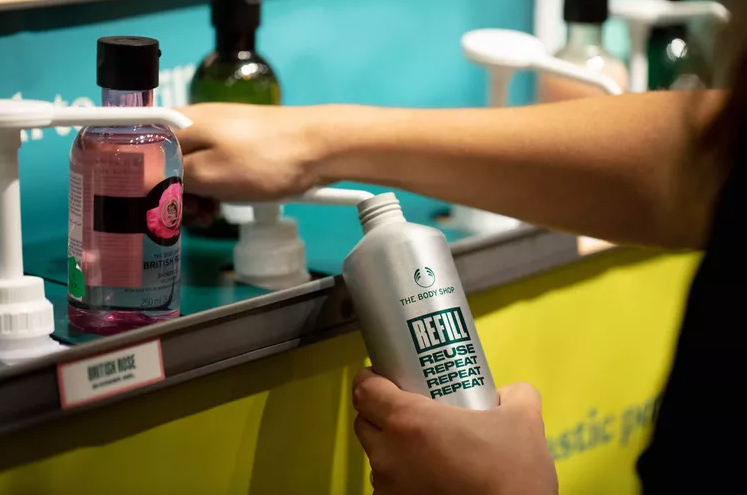
Retailers are also normalising refills. Selfridges claims to offer 900 refillable fragrances from 48 brands, providing in-store refilling for selected scents, while legacy brands are establishing physical refill stations. The Body Shop has refill stations in 720 stores worldwide, and L’Occitane’s UK “refill fountains” are paired with reusable aluminium “Forever Bottles”.
Finally, regulation is tightening the definition of ‘good packaging’. In the EU, the Packaging and Packaging Waste Regulation (PPWR) (Regulation (EU) 2025/40) promotes recyclable packaging, minimises materials and introduces fee modulation through Extended Producer Responsibility (EPR). The legal text was published on 22 January 2025 and will generally apply from 12 August 2026, with transition periods for specific requirements. The message for the cosmetics industry is clear: even when reuse is not mandated for a product category, it will become increasingly difficult to justify the use of non-recyclable, overbuilt packaging.
Three refill models, three very different packaging problems
1) At-home refills (pouches and refill bottles)
This is the fastest to scale because it doesn’t depend on store infrastructure. However, the end-of-life packaging is problematic: the lightest refill is often a multi-material film structure that is difficult to recycle. This is why the next stage of development is focusing on mono-material films and simpler components that can meet ‘design for recycling’ expectations.
2) In-store refilling (fountains, refill bars and assisted refilling)
Here, hygiene and consumer confidence are paramount. The ‘forever’ pack must be durable and easy to clean while still feeling premium. Aluminium is a common choice in these concepts: L’Occitane states that its Forever Bottles are made from 100% recycled aluminium and are recyclable. The Body Shop pairs refills with aluminium bottles, and Bloom Refill positions its dispensers as being made from 100% recyclable, food-grade aluminium.
3) Inserts and cartridges (refillable compacts and capsules)
Make-up is becoming a design laboratory for refill mechanics, as refills can be rigid and easy to swap. For example, Charlotte Tilbury markets a range of refillable make-up and skincare products (including creams, powders, and lip products) built around replaceable components.
Kiehl’s: scaling up refills and addressing packaging issues
Kiehl’s is a useful case study because it demonstrates the challenges of scaling up refills beyond the pilot stage. As part of its Refillery programme, the brand offers in-store refilling and at-home pouches for six popular products. According to Trellis, refill sales doubled in 2024 and refill SKUs accounted for 16% of transactions across these products.
The material savings are also impressive: a 150 ml facial cream pouch can refill a 50 ml jar three times, reducing packaging materials by 61%, while shampoo pouches cut the product’s plastic footprint by 81%. Kiehl’s also claims that its Ultra Facial Cream refill pouch uses 61% less plastic and can fill three 50 ml jars.
However, Trellis also highlights an issue: multi-material pouches are not easily recyclable, and the brand intends to transition to mono-material film in 2026. In other words, while the refill proposition can be strong in terms of “source reduction”, it still struggles in terms of “end-of-life” until waste infrastructure (and packaging design) catches up.
How do refillable products change packaging design?
Refills force a shift in focus from the packaging itself to the way it is used. Three priorities rise to the top:
- Durability and cleanability: closure wear, decoration resistance and pump longevity become design constraints rather than desirable extras.
- Component architecture: keeping the parts that are hardest to recycle (such as pumps and droppers) in use for longer often has a greater impact than just changing the bottle.
- Materials that perform well and can be recycled: durable, widely recyclable materials (such as aluminium) work well for refill concepts but only if the system remains convenient enough to encourage repeat use. Mintel’s conclusion is straightforward: convenience remains the defining barrier.
The refillable beauty market is growing because it meets the current needs of brands: measurable waste reduction, repeat purchase mechanics and a narrative that consumers can relate to. However, it only becomes ‘sustainable packaging’ when the entire system is designed with this in mind: from the durable primary packaging to the refill format that is designed for real recycling pathways and a user experience that makes the second purchase easier than the first.
Image Credits: The Body Shop