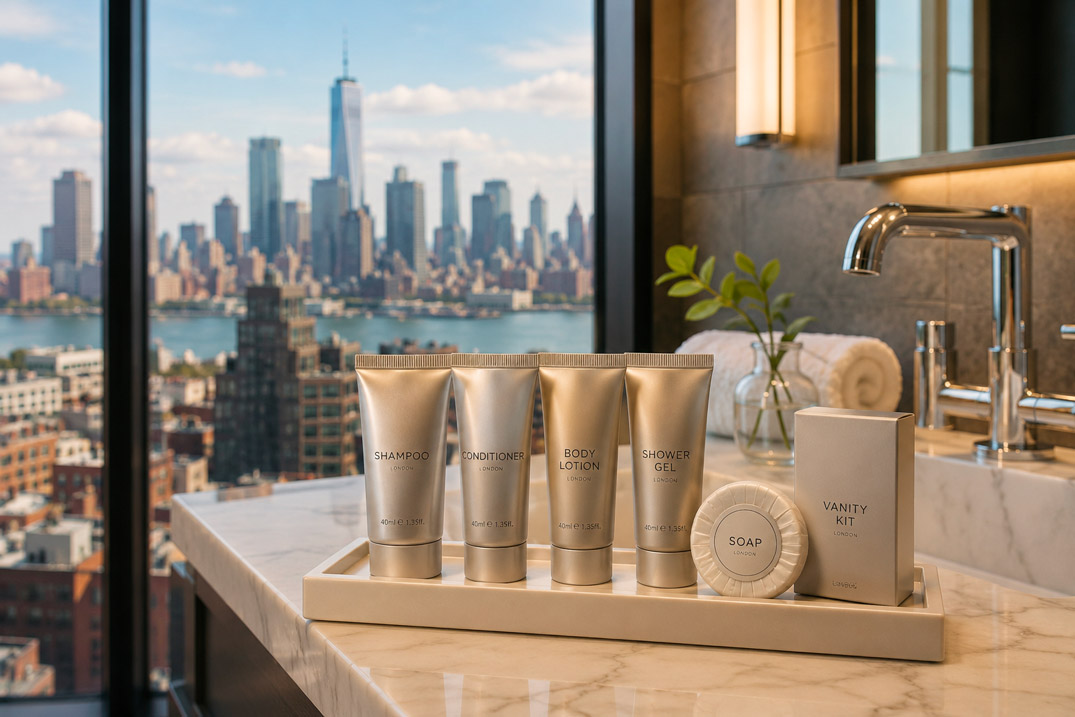
There is something oddly familiar about opening the bathroom door of a hotel room. Whether the hotel is in New York, Milan, Dubai or Singapore, guests are often greeted by the same collection of miniature products neatly arranged beside the sink or shower: shampoo, conditioner, body lotion, soap and other personal care items designed to make a stay more comfortable. These products have become such a natural part of the hospitality experience that few people stop to think about them. Yet behind this seemingly simple ritual lies one of the packaging industry’s least discussed sustainability challenges.
For decades, hotel amenities have represented convenience, hygiene and, in many cases, a sense of quality. They have helped hotels reinforce their brand identity, create a more premium guest experience and offer travellers practical products that can be used during a stay or taken home afterwards. The model has worked remarkably well for the hospitality industry, which is perhaps why it has remained largely unchanged even as packaging systems in many other sectors have undergone significant transformation.
Today, however, the context surrounding packaging is very different from the one in which miniature hotel amenities first became widespread. Across industries, companies are facing increasing pressure to reduce packaging waste, improve recyclability and demonstrate progress toward broader sustainability goals. Regulations such as the Packaging and Packaging Waste Regulation (PPWR) are accelerating the shift toward more circular packaging systems, while brands are being challenged to rethink formats that were once considered standard. Against this backdrop, the traditional hotel amenity model increasingly feels disconnected from the direction in which the wider packaging industry is moving.
Why hotel amenities have escaped the sustainability debate
This does not mean that individual amenities will disappear. In fact, the hospitality sector faces a particularly complex challenge because it sits at the intersection of two powerful trends. On one side is the growing demand for sustainability and waste reduction. On the other is the desire to preserve the guest experience that many hotels consider central to their value proposition. Unlike other packaging applications, hotel amenities are not judged solely on efficiency or functionality. They are part of the overall perception of a stay, influencing how guests experience comfort, quality and attention to detail.
For this reason, the conversation around hotel packaging is often more nuanced than it first appears. Refillable dispensers have become increasingly common and can significantly reduce packaging consumption, particularly for products such as shampoo and shower gel. Many large hotel chains have embraced this approach as part of broader sustainability initiatives. Yet refill systems are not universally adopted, particularly in luxury hospitality, boutique hotels and travel-oriented environments where individually packaged products continue to be seen as part of the guest experience. For many properties, the question is not simply whether individual amenities should exist, but how they can evolve to better align with modern sustainability expectations.
Rethinking materials, not just packaging formats
This is where material choice becomes particularly interesting. Historically, most hotel amenities have relied on lightweight plastic bottles and containers because they are inexpensive, durable and easy to produce at scale. However, as hospitality brands increasingly look for ways to combine sustainability with premium presentation, alternative materials are attracting greater attention.
Among these, aluminium offers a compelling possibility, particularly for products such as body lotions, creams, balms and other personal care formulations. While discussions around sustainable hospitality packaging often focus on eliminating single-use formats altogether, aluminium suggests a different approach: improving the sustainability profile of those formats that are likely to remain part of the guest experience.
From a packaging perspective, aluminium combines several characteristics that are particularly relevant to hospitality. It provides excellent protection for cosmetic formulations, offers a premium appearance that aligns naturally with hotel branding and can be recycled repeatedly without significant loss of material quality. These qualities have made aluminium an increasingly attractive material across a range of packaging applications where both product protection and sustainability matter.
There is also an often-overlooked behavioural aspect. Unlike many miniature plastic bottles that are discarded shortly after use, aluminium tubes are more likely to be retained by travellers. Guests frequently place them in a suitcase and continue using the product long after checkout, particularly when travelling between destinations. Their resistance to leaks, crushing and travel-related damage makes them especially well suited to life on the move. In this sense, the packaging begins to serve a longer purpose, extending its useful life beyond the hotel room itself.
What hospitality packaging could look like in the future
Of course, aluminium is not a universal solution, nor will it replace refill systems where those models make sense. The broader point is that hospitality may need to expand the conversation beyond a simple choice between disposable amenities and refillable dispensers. As packaging sustainability becomes increasingly sophisticated, the industry is learning that meaningful improvements often come not from a single solution but from a combination of smarter formats, better materials and more thoughtful system design.
The hospitality sector is unlikely to solve its packaging challenges overnight. Guest expectations will continue to evolve, refill models will continue to grow and material innovation will continue to reshape what is possible. What seems increasingly clear, however, is that hotel amenities can no longer be considered separate from the wider transformation taking place across the packaging industry.
For years, these products escaped the scrutiny applied to many other packaging categories. Yet as circular economy principles become more deeply embedded in business strategies and regulatory frameworks continue to push companies toward more sustainable packaging solutions, one of the industry’s most familiar packaging formats may finally be approaching its own moment of reinvention.
The future of hotel amenities will not depend solely on the products offered to guests. Increasingly, it may depend on how thoughtfully those products are packaged.