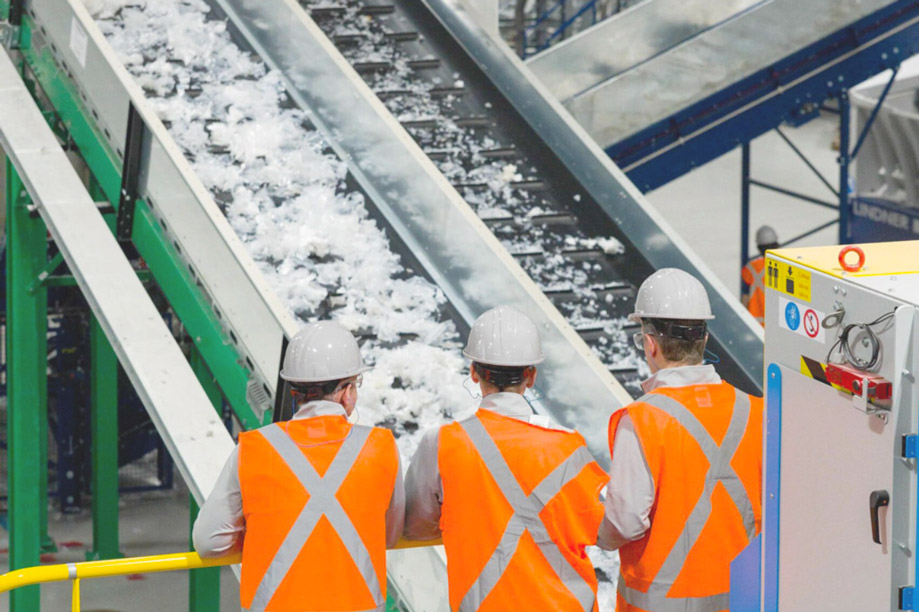
For years, the conversation around food-contact recycled plastics has been almost exclusively about PET. If you wanted to include recycled content in food packaging, your options were largely limited to clear bottles and trays. But the landscape is shifting. Nova Chemicals has recently announced the commercialization of its SYNDIGO™ portfolio, signaling that mechanically recycled polyethylene (rPE) is ready for its seat at the table: rPE-0860-FC. This resin is sourced from natural HDPE bottles, such as milk jugs, and can be used as a blend component in both rigid and flexible packaging, enabling brand owners to incorporate post-consumer content without having to rewrite their entire packaging specification.
Nova presents SYNDIGO as 100% post-consumer, mechanically recycled resin with third-party certification: an important detail for packaging teams trying to reconcile recycled content targets with food safety and consistency requirements.
Why this matters: Polyolefins (PE and PP) are the workhorses of food packaging, especially in flexible formats, but they have also been the most difficult to ‘close the loop’ with mechanical recycling due to feedstock variability, contamination risk and performance losses. The hope is that tighter feedstock selection, robust decontamination, and rigorous quality control can unlock a new level of ‘fit-for-food’ recycled content.
Notably, the company also lists recycled linear low-density PE (rLLDPE) grades as suitable for food contact, with FDA ‘Conditions of Use’ covering multiple temperature/time scenarios (e.g. B–H or E–G, depending on the grade). In practice, this is important because it determines whether a recycled resin can be used for chilled products, ambient storage or more demanding applications, and it provides clear guidelines for converters on how the material can be used (typically via blending, multilayer design and validated process control).
Regulators are also making progress, but not necessarily at the same pace. In the US, for example, the FDA’s public database of No Objection Letters indicates an increasing number of favourable opinions regarding post-consumer recycled plastics, including polyolefins. This signals growing confidence in both mechanical and advanced recycling processes for food packaging.
In the EU, Regulation (EU) 2022/1616 establishes a framework whereby recycling technologies must be deemed ‘suitable’ and recycling processes authorised and registered before recycled plastic can be used in food-contact applications. There is a strong emphasis on decontamination and traceability. The Commission has noted that the formally established “suitable” technologies include mechanical PET recycling and closed-and-controlled chains, which serves as a reminder that food-grade recycled polyolefins are still an emerging field in Europe.
The next things to watch are scale and repeatability. Food brands want recycled content that behaves like virgin resin in terms of sealability, stiffness, odour neutrality and migration safety, and that is available in consistent volumes. If suppliers can deliver this, recycled polyethylene (PE) could transition from niche trials to mainstream use, initially as a blend component and subsequently in higher-percentage structures as collection and sorting systems mature.
Credits Image: Nova Chemicals