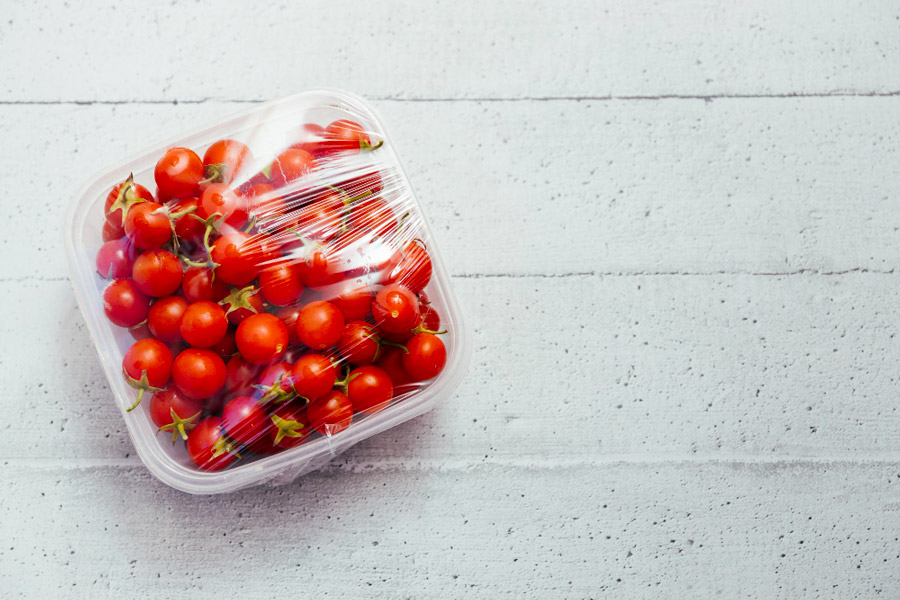
Let’s get it real: packaging waste is a problem that Europe can no longer put off; the EU generated 79.7 million tonnes of packaging waste in 2023: this corresponded to 177.8 kg per inhabitant, a reduction of 8.7 kg per capita compared with 2022 (Eurostat); 19.8% of this is plastic waste (almost 16 million tonnes), second only to cardboard (40.4 %). But plastic undoubtedly poses greater concerns in terms of environmental impact.This is also because replacement is not always straightforward: while a plastic bag can easily be replaced by a paper or cloth bag, the same cannot be said for wrapping materials, such as food contact films, which have the delicate task of preventing food waste and maintaining product (and consumer) safety.
The pressure to replace conventional films is real. The problem: food packaging still needs barrier, safety, and industrial speed, and “paperisation” doesn’t always deliver.
The uncomfortable truth: paper isn’t a universal “plastic replacement”
Paper has momentum, and it’s already the biggest material share in EU packaging waste.
But switching to paper doesn’t automatically mean circular, especially when performance requirements push brands toward coatings, laminations, inks, tapes, foils and other add-ons that complicate recycling. Gift wrap is the simplest real-world example: many papers contain non-paper components (glitter, metallic elements, plastic coatings, heavy dyes) that make recycling impractical.
And in transport/multipack applications, the trade-offs can be harsher: Packaging Europe has pointed out cases where paper-based alternatives to plastic wrap correlate with higher product damage and food waste: a sustainability failure in disguise.
Let’s talk about moisture and grease resistance, heat sealing, and shelf-life protection, paper often needs a little help (Aka: a plastic reinforcement, which, although thin, can compromise the recyclability of paper packaging, either in whole or in part.)
That’s where truly “innovative materials” must come to a rescue.
Making fibre actually work: Lactips and the new generation of barrier coatings
Lactips is an interesting example of innovative coating, because it tackles the real bottleneck: the barrier layer that typically turns a fibre pack into a recycling headache.
- On its own materials pages, Lactips positions its coating as enabling full fibre recovery in paper recycling because the resin is water-soluble, so it can pass through the process without leaving sticky residues unlike conventional PE coatings that often require separation steps.
- The company also frames its coated paper solutions as plastic-free / PFAS-free, and designed to be compatible with the paper recycling stream.
- The EU’s CORDIS coverage of Lactips’ work (ECOLACTIPACK context) reinforces the logic: improve paper’s barrier while keeping it suitable for recycling and food contact applications.
Lactips isn’t betting on “paper replaces film.” It’s betting on barrier technology that lets paper compete in categories where it previously couldn’t , without locking fibre out of recycling.
Futamura NatureFlex and the case for cellulose-based flexibles
If fibre can’t do the job alone, and plastics are under pressure, the market keeps circling back to cellulose films, especially where brands need a film format (wrap, flowpack, overwrap) but want different end-of-life options.
Cellulose films sit in a pragmatic middle ground, familiar to converters, compatible with many flexible formats, and engineered around performance rather than ideology.
Futamura’s NatureFlex™ range is positioned as renewable and compostable, derived from wood pulp sourced from responsibly managed forests, and available in multiple grades aimed at different packaging needs.
Crucially, Futamura doesn’t sell “one miracle film.” It sells a product portfolio including high-barrier options for moisture-sensitive products and semi-permeable films designed for cheese wraps, where controlled transmission can actually be part of the performance spec.
NatureFlex’s dedicated site also frames the materials as cellulose-based and aligned with composting standards (home/industrial claims vary by grade and market).
Two more “film-first” routes are moving in parallel:
- Recyclable mono-material: Mamata’s RecTech is described as a mono-material film aiming for barrier/mechanical performance comparable to common composites like PET+PE and PET+MPET+PE.
- Biodegradable multilayers via nanolayers: Peak Nano is pursuing nanolayered biodegradable multilayer barrier films using its NanoPlex technology, explicitly targeting food and beverage packaging.
The takeaway is simple: there won’t be a single “winner material” that replaces plastic (and paper alone won’t do it either). The next wave of sustainable flexible packaging is being built in the grey area where barrier performance, food-contact safety and end-of-life have to coexist.
That’s why solutions like Lactips’ water-soluble barrier coatings and cellulose films such as NatureFlex deserve attention: they don’t rely on feel-good substitution, but on making packaging work as a system, from protection to sorting to real-world recovery. In parallel, “film-first” routes like recyclable mono-material structures (RecTech) and engineered biodegradable multilayers (Peak Nano) show that the industry is trying to solve the same puzzle from different angles.What happens next will be decided by proof points: line-speed performance, validated barrier data, regulatory pathways for food contact, and credible end-of-life claims aligned with local infrastructure. In a market under growing scrutiny, and with a packaging waste still measured in tens of millions of tonnes, these innovations aren’t just nice-to-have. They are becoming the only realistic way to keep food safe without locking packaging into a waste problem.